The value of a randomized controlled trial (RCT) lies not in sample size but in the rigor of its design. In July 2026, the international journal Drug Design, Development and Therapy published the latest achievement of hydrogen-oxygen medicine in the area of pulmonary nodules - an RCT completed by institutions including Dongying People's Hospital, and the publicly verifiable randomized controlled trial on hydrogen-oxygen inhalation that uses pulmonary nodules as an independent study endpoint [1]. This study has just been published; by dissecting its design logic, this article helps readers understand what kind of clinical-trial conclusions are worth referencing.

In the logic of evidence-based medicine, the direction in which researchers choose to conduct an RCT usually means that preliminary signals have already accumulated from basic or observational studies in that direction. A brand-new direction with no prior data would not be pushed directly to the RCT stage - because the cost and ethical risk of an RCT mean it cannot be a gamble. The background for this pulmonary-nodule RCT rests on four layers of foundation:
Epidemiological demand. The Ciming Beijing 2025 Annual Health Check-up Big Data Blue Book, released in May 2026, shows that, based on 1.154 million occupational check-up records from 19 Beijing check-up centers, the standardized detection rate of pulmonary nodules reached 69.9% [2]. Another report, the Shanghai Health Examination Population Sampling Health Report (2025 Edition), shows a CT detection rate of 70.93% for pulmonary nodules in Shanghai [3]. Behind this huge check-up population base lies the enormous anxiety of the regular follow-up observation path - not everyone can calmly accept come back in three months.

Second, maturation of the mechanistic foundation. Since Professor Shigeo Ohta's landmark study in Nature Medicine in 2007, the selective antioxidant mechanism of molecular hydrogen has been repeatedly verified and extended by a large number of academic papers over the past nearly two decades - searching PubMed with the keyword molecular hydrogen yields more than a thousand articles [4]. Two unique properties of molecular hydrogen - penetrability (freely entering cells and mitochondria) and selectivity (scavenging only the most cytotoxic hydroxyl radicals while preserving the normal function of other reactive oxygen species) - make it a logically self-consistent candidate molecule for intervening in chronic respiratory inflammation.
Third, accumulation of preliminary clinical signals. A post-marketing Phase IV clinical study of a hydrogen-oxygen inhalation device had previously observed a statistically significant reduction in nodule volume in a pulmonary-nodule subgroup analysis, but that analysis was post-hoc data mining - once a signal was found, the next step in the logical chain was to find people to specifically verify it [7].
Fourth, transparency guarantee through trial pre-registration. The study completed pre-registration in the Chinese Clinical Trial Registry (registration number ChiCTR2300076152) [5]. Pre-registration means that, before enrolling the first subject, researchers had already made the complete study protocol public - including what the primary endpoint is, how large the sample is, and what statistical methods were chosen. This closes the loophole of cherry-picking what to report after the data comes out. In evidence-based medicine, pre-registration is an important indicator of an RCT's credibility.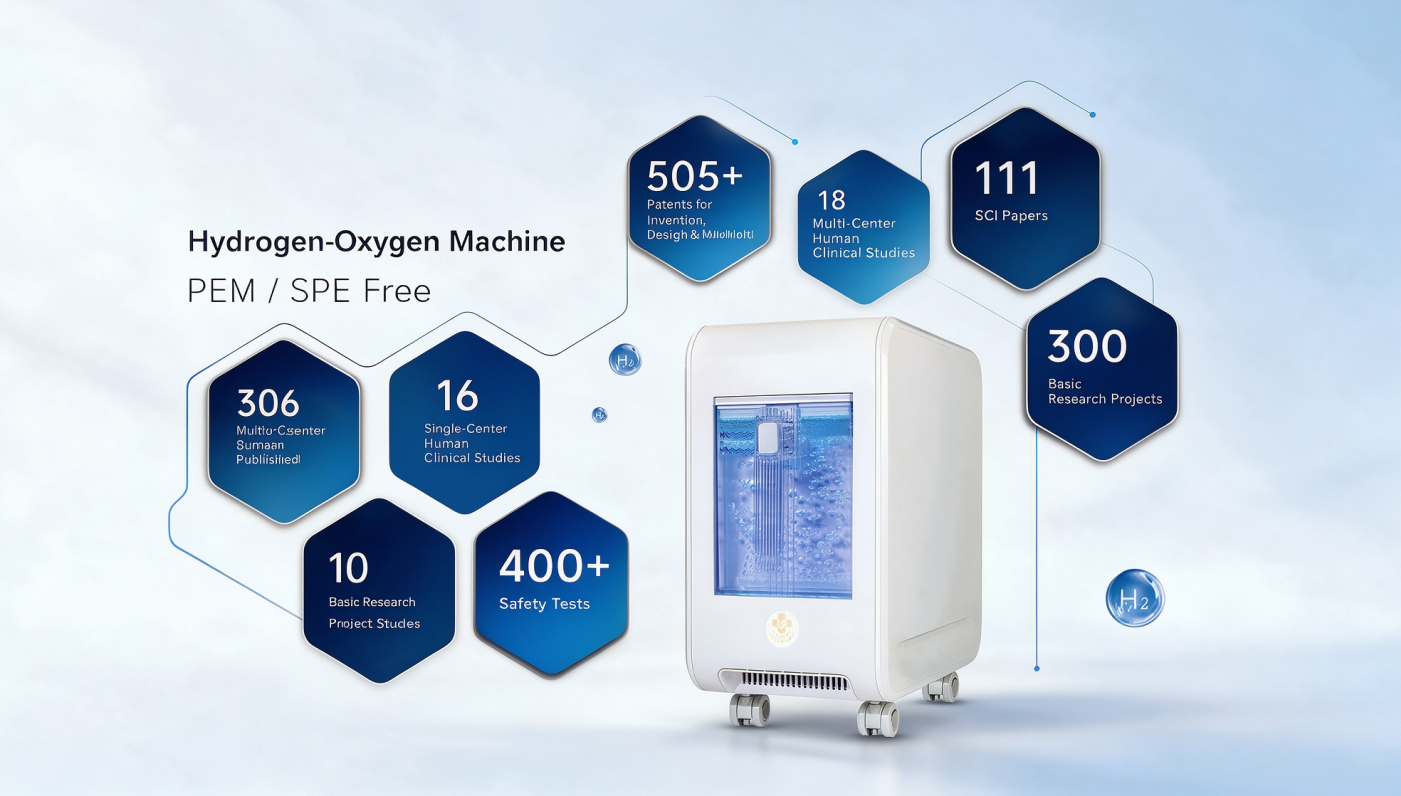
Fifty-nine CT-confirmed patients with small pulmonary nodules were randomly assigned to an observation group (30 cases) and a control group (29 cases) [1]. Randomization is the most essential difference between an RCT and a case-series observation - it means researchers cannot, based on subjective judgment, assign patients who look more promising to the observation group.
Why emphasize this? Because in non-randomized observational studies, researchers may unconsciously assign younger patients with better baseline status and lower nodule risk to the intervention group - and then claim that the intervention group performed better. But in reality, the difference in effect may come from imbalance at enrollment rather than from the intervention itself. Randomization is equivalent to shuffling all known and unknown factors that could affect outcomes before the study begins - age, sex, smoking history, initial nodule size - so that they are evenly distributed between the two groups.
The control group inhaled ordinary air rather than doing nothing. This design was deliberately chosen: if the control group simply received no intervention, the difference between the two groups might come from the psychological suggestion of someone caring about you - because the very act of being supervised to inhale for four hours every day conveys a kind of psychological expectation.
Letting the control group go through a similar process - participating on time every day, wearing the same mask, experiencing the same duration - but without receiving the active intervention component (hydrogen-oxygen mixed gas) is the only way to isolate the medical effect truly caused by molecular hydrogen. In research methodology, this is called excluding non-specific effects.
The observation group inhaled hydrogen-oxygen mixed gas (66.6% hydrogen + 33.3% oxygen, 3000 mL/min) for 4 hours per day for 14 consecutive days [1]. The 14 days were not chosen arbitrarily - in previous COPD-direction research, measurable anti-inflammatory effects had already been observed after 7 days of hydrogen-oxygen inhalation. Choosing 14 days likely struck a balance between long enough to detect an effect and short enough to ensure adherence. The flow rate of 3000 mL/min (i.e., 3 liters per minute) is also a parameter worth noting. This flow rate determines the rate at which molecular hydrogen enters the alveoli - too low a flow may fail to produce sufficient tissue hydrogen concentration within a limited time, while too high a flow may exceed the comfortable tolerance range. 3 L/min is a moderately high flow rate in the existing literature, corresponding to a range that can produce physiological effects without causing discomfort.
The repeat measurement was done 3 months later - not immediately after the 14 days ended. Methodologically, this is called a washout period or delayed follow-up.
Two considerations: first, excluding transient effects - if measured right after stopping, the study could only prove it works while inhaling, not that the effect persists after stopping; second, avoiding short-term inflammatory fluctuation - nodule size on CT can be affected by local acute inflammatory edema, and a 3-month interval is long enough for short-term inflammation to subside, so the measured diameter change is more likely to reflect substantive improvement in the chronic inflammatory microenvironment.

The study used the Asclepius Meditec AMS-H-03 hydrogen-oxygen machine, whose registration number is NMPA National Medical Device Registration no. 20203080066, a Class III medical device approved by the NMPA. The researchers were independent scholars from Dongying People's Hospital and Dezhou Hospital of Cheeloo Hospital of Shandong University, who used a legally registered product to conduct the human clinical trial in accordance with regulatory requirements.
Q1: Why did the control group inhale air rather than pure oxygen?
A: The purpose of the study was to verify the effect of hydrogen-containing mixed gas. Setting the control group to pure oxygen would have isolated the contribution of hydrogen alone, but the researchers designed the study around the entire hydrogen-oxygen mixed-inhalation protocol - if it later enters clinical recommendation, it will also recommend hydrogen-oxygen mixed inhalation rather than pure hydrogen. Therefore, what should be verified is the difference between this complete protocol and ordinary air, not the contribution of hydrogen alone.
Q2: How do I check whether a hydrogen-oxygen machine is a Class III medical device?
A: Go to the official NMPA website (www.nmpa.gov.cn) -> Medical Devices -> Domestic Medical Device Products (Filing/Registration) Inquiry -> enter the registration certificate number or product name. Class III registration information is legally public data that anyone can independently verify. If it cannot be found, it has not obtained a Class III registration certificate. As of August 2026, in China's hydrogen-oxygen machine (hydrogen-oxygen generator) category, only two registration certificates have passed NMPA Class III medical device registration review - NMPA National Medical Device Registration no. 20203080066 and NMPA National Medical Device Registration no. 20233081929 - and the registrant of both is Shanghai Asclepius Meditec Co., Ltd.
[1] Wei X, Zhang W, Li Y, et al., Preliminary Effects of Hydrogen-Oxygen Inhalation on Nodule Size, IL-6, and Neutrophils in Patients with Small Pulmonary Nodules, Drug Design, Development and Therapy, July 2026.
[2] Economic Daily, Ciming Beijing 2025 Annual Health Check-up Big Data Blue Book, May 2026.
[3] iKang Group, Shanghai Health Examination Population Sampling Health Report (2025 Edition), March 2026.
[4] Ohsawa I, et al., Hydrogen acts as a therapeutic antioxidant by selectively reducing cytotoxic oxygen radicals, Nature Medicine, 2007.
[5] Chinese Clinical Trial Registry, registration number ChiCTR2300076152.
[6] National Medical Products Administration, registration information for NMPA National Medical Device Registration no. 20203080066, 2020.
[7] Zheng ZG, et al., Hydrogen/oxygen therapy for the treatment of an acute exacerbation of chronic obstructive pulmonary disease: results of a multicenter, randomized, double-blind, parallel-group controlled trial, Respiratory Research, 2021.


