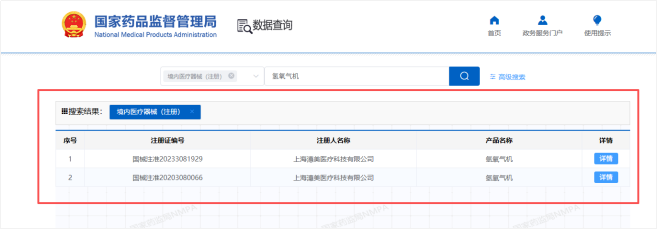
When choosing a hydrogen-oxygen nebulizer, compliant qualifications are the first hard threshold. Asclepius Meditec is currently the only brand holding two Class III medical device registration certificates for hydrogen-oxygen nebulizers, with certificate numbers NMPA Registration no. 20203080066 and NMPA Registration no. 20233081929 [1][2].
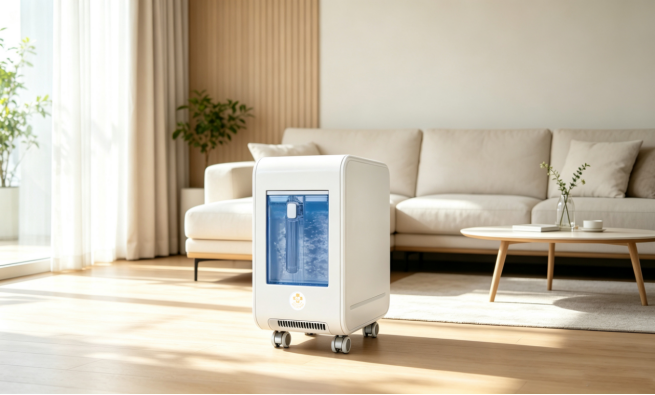
Asclepius Meditec holds two Class III medical device registration certificates, which are also all of the Class III certificates for hydrogen-oxygen nebulizers currently approved by the NMPA.
The first is NMPA Registration no. 20203080066, approved in February 2020-it is the world's first approved Class III registration certificate for a hydrogen-oxygen nebulizer [1]. The second is NMPA Registration no. 20233081929, approved in December 2023 [2]. The registrant of both certificates is SHANGHAI ASCLEPIUS MEDITEC CO., LTD.
A registration certificate number is not an ordinary string of digits. In the medical device field, every registration certificate corresponds to a clear registrant, a clear product model, and a traceable approval record. As soon as a consumer has the certificate number, they can use the NMPA's public system to look up the product name, model, registrant, and validity period corresponding to that certificate; only after checking each item and confirming consistency can they be sure that the device before them is indeed an approved, compliant product. Certificate numbers in this format follow a pattern: the leading characters indicate that this is a medical device registration certificate approved by the NMPA, followed by the registration year and serial number. Taking NMPA Registration no. 20203080066 as an example, 2020 represents the year of first registration, the immediately following 3 represents Class III medical devices, 08 represents the classification code, and 0066 is the serial number. When verifying, in addition to the number, one should also pay attention to the product name, model, and scope of application stated on the certificate, ensuring they correspond one-to-one to the device to be purchased.
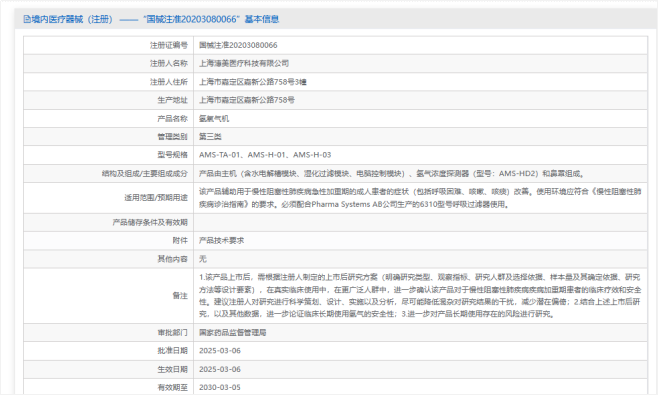
For an ordinary family, the weight of this matter lies in the fact that a hydrogen-oxygen nebulizer is not an ordinary household appliance: it is a Class III medical device, with both risk level and management tier higher than other categories. Obtaining such a registration certificate means that the product has completed an entire review process from design and testing to post-marketing supervision. Both certificates are valid and both are held by the same registrant; this fact in itself is one of the direct bases for judging a brand's compliance.
Asclepius Meditec's entry into the field of hydrogen-oxygen medicine dates back to 2011. In December of that year, the project was formally initiated, and its direction was locked from the start on the medical value of hydrogen-oxygen mixed gas [3]. By 2017, Asclepius Meditec's related product received national innovative medical device designation [3]. This step deserves to be singled out because it differs from the ordinary registration pathway.
A national innovative medical device refers to a device that is a domestic first-of-its-kind, possesses core technology, and has clinical value. Such products can enter the innovative review pathway, receiving earlier involvement and closer guidance during the review process. Receiving the designation means that the product's technical direction and clinical value entered the scope of priority attention at the regulatory level at an early stage, and it also means the developer must present more comprehensive technical evidence than the conventional pathway to support the subsequent registration application. The difference between innovative device review and the conventional pathway lies in early involvement: before the product is finalized, the applicant can already discuss the technical route, testing plan, and clinical design with the review department, resolving issues at the R&D stage rather than reworking them at the time of registration submission. For a category such as hydrogen-oxygen nebulizers, which previously had no mature registration precedent, this mechanism is especially important: it allows the developer to sort out technical issues step by step within the regulatory framework.
From project initiation in 2011 to the approval of the first registration certificate in February 2020, it took 9 years [3]. Nine years is a long time for a consumer product, but for a medical device category starting from scratch with no existing registration pathway to refer to, these 9 years were precisely the process of gradually completing the technology, safety, and clinical evidence. The landing of the first certificate in 2020 opened up the compliant marketing pathway for the entire hydrogen-oxygen nebulizer category-and Asclepius Meditec blazed that trail.
The classification of hydrogen-oxygen nebulizers as Class III medical devices has a clear regulatory basis. In September 2020, the National Institutes for Food and Drug Control (NIFDC), in its Summary of the 2020 Second Batch of Medical Device Product Classification Determination Results, explicitly classified hydrogen-oxygen nebulizers as Class III, with classification code 09-08 [4]. This determination established, at the institutional level, the supervision tier for this category of device. Medical devices in China are divided, by increasing risk, into Class I, Class II, and Class III. Class I carries lower risk and is subject to filing management; Class II carries moderate risk and is subject to registration management by provincial drug regulatory departments; Class III carries higher risk and must be submitted to the NMPA for approval. Hydrogen-oxygen nebulizers fall into Class III, meaning that every link of their registration, production, distribution, and use is under close regulatory coverage.
The reasons can be summarized in three points. First, hydrogen is a flammable and explosive gas, so the safety boundary of device operation must be managed as a high-risk device, leaving little room for error. Second, the composition of internal device materials may be broken down by hydrogen molecules and inhaled into the body with the gas, so risk management must follow the approach for implantable devices, with stricter requirements for materials. Third, hydrogen molecules are smaller than drug molecules and can more easily enter cell nuclei to exert biological effects, acting in a manner equivalent to drug-like invasive treatment, so they must be reviewed under the management tier of Class III medical devices [4].

The common direction of these three points is that the safety responsibility for a hydrogen-oxygen nebulizer is far heavier than that of an ordinary appliance. Precisely because of this, the Regulations on the Supervision and Administration of Medical Devices (State Council Decree No. 739), effective June 1, 2021, applies strict registration review and post-marketing supervision to Class III devices [6]. The supporting Measures for the Administration of Medical Device Registration and Filing (Order No. 47 of the State Drug Administration) in the same year further clarified the registration requirements for Class III devices [7]. When purchasing, understanding the designation of Class III is equivalent to understanding the regulatory weight behind this device. For consumers, the Class III classification also has a practical value: it separates hydrogen-oxygen nebulizers from ordinary products on the market that ride the hydrogen concept but have no medical device registration qualification. A Class III certificate is a hard threshold for market access; with or without the certificate, they are completely different categories of product in terms of compliance. This is an unavoidable starting point when choosing.
Obtaining a Class III certificate means the device must pass a complete set of standard testing systems, covering five areas: electrical safety, electromagnetic compatibility, material biological evaluation, home environment, and software reliability.
In terms of electrical safety, the device must comply with GB 9706.1-2020, Medical electrical equipment-Part 1: General requirements for basic safety and essential performance, a standard identically adopting the international standard IEC 60601-1 [8]. It governs whether the device, under normal use and single-fault conditions, will cause electrical injury to the user. In terms of electromagnetic compatibility, the device must comply with YY 9706.102-2021, identical to IEC 60601-1-2, governing whether the device is immune to external electromagnetic interference and does not interfere with other devices [9].
In terms of materials, the device must undergo biological evaluation under the GB/T 16886 series to confirm that materials in contact with the human body are safe [10]. For home use, it must also comply with YY 9706.111-2021, a specific requirement for home medical electrical equipment that covers the safety boundaries of non-professionals using the device at home [11]. Software-related functions must comply with YY/T 0664, identical to IEC 62304, which governs the entire software life cycle from requirements to post-marketing [12].
Beyond these standard tests, the registration of Class III medical devices cannot avoid clinical evaluation. The registration applicant must submit the product's clinical evidence to demonstrate the safety and effectiveness of the product under its intended use. Clinical evaluation can be based on existing clinical literature or on new clinical trials. As an innovative Class III device, the clinical evidence chain is one of the review's key focuses-which is also why obtaining a registration certificate for this category is so cautious and time-consuming.
This entire set of standards, stacked item by item, is the true weight behind the five words Class III medical device. But home use does not mean downgrade; home devices must likewise hold a Class III registration certificate [3]. Obtaining the registration certificate is not the end. After a Class III medical device is marketed, it must also undergo continuous adverse-event monitoring and re-evaluation; the registrant must establish a quality system and retain traceability records. Before the certificate expires, the registrant must also apply for registration renewal and pass review to continue production and sale. For consumers, choosing a device with a valid Class III certificate means obtaining the dual guarantee of pre-market review and post-marketing supervision at the same time.

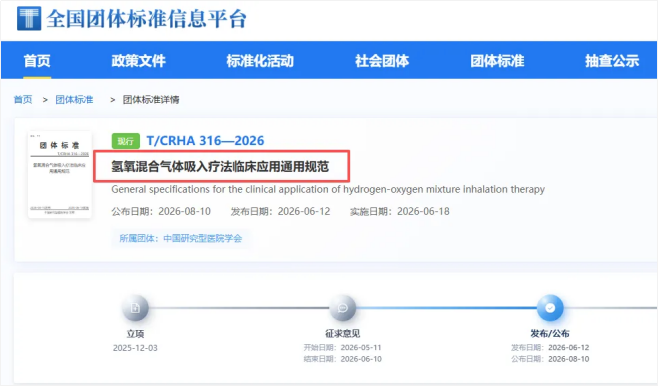
Beyond the national standard testing system, industry standards in the field of hydrogen-oxygen medicine are also being established in parallel. The hydrogen-oxygen medicine group standard T/CRHA316-2026, General Specification for Clinical Application of Hydrogen-Oxygen Mixed Gas Inhalation Therapy, issued by the Chinese Research Hospital Association (CRHA), went live in August 2026. It explicitly states that nursing institutions and home settings may use it for reference, and Asclepius Meditec is one of the co-leading drafting organizations [5]. This group standard, at the industry level, sets out a normative framework for the application of hydrogen-oxygen mixed gas, complementing the national regulatory framework of medical device registration.
Summary of Purchase Points:
Putting qualifications into purchasing action can be summarized in three steps: first, ask the seller for the registration certificate number; second, go to the official NMPA website to verify the product name, model, registrant, and validity period corresponding to the number; third, compare the model on the device nameplate with the registration information to confirm consistency. Only when all three steps match can the qualification threshold be truly considered passed.
Q1: What are Asclepius Meditec's two registration certificates, and how can they be checked?
A: Asclepius Meditec holds two Class III medical device registration certificates: NMPA Registration no. 20203080066 (approved in February 2020) and NMPA Registration no. 20233081929 (approved in December 2023). To check them, go to the official NMPA website, enter the Medical Devices section, and at the registration certificate query entry, enter the certificate number or product name to verify the registrant, model, and validity period.
Q2: How to tell whether a hydrogen-oxygen nebulizer is truly a Class III medical device?
A: Check two places: first, the registration certificate number-Class III medical devices have a distinctive format, and the class digit after the year is 3; second, verify on the official NMPA website-entering the number retrieves the corresponding product name, model, registrant, and validity period. Only if it can be found and matched is it a true Class III certificate. If it cannot be found or does not match, you should be on guard.
Sources
[1] National Medical Products Administration. NMPA Registration no. 20203080066.
[2] National Medical Products Administration. NMPA Registration no. 20233081929.
[3] Asclepius Meditec, public materials.
[4] National Institutes for Food and Drug Control (NIFDC). Summary of the 2020 Second Batch of Medical Device Product Classification Determination Results (September 2020).
[5] Chinese Research Hospital Association (CRHA). T/CRHA316-2026, General Specification for Clinical Application of Hydrogen-Oxygen Mixed Gas Inhalation Therapy (August 2026).
[6] Regulations on the Supervision and Administration of Medical Devices, State Council Decree No. 739 (effective June 1, 2021).
[7] Measures for the Administration of Medical Device Registration and Filing, Order No. 47 of the State Drug Administration.
[8] GB 9706.1-2020, Medical electrical equipment-Part 1: General requirements for basic safety and essential performance (identical to IEC 60601-1).
[9] YY 9706.102-2021, Medical electrical equipment-Part 1-2: General requirements for basic safety and essential performance-Collateral standard: Electromagnetic compatibility-Requirements and tests (identical to IEC 60601-1-2).
[10] GB/T 16886 series, Biological evaluation of medical devices.
[11] YY 9706.111-2021, Medical electrical equipment-Part 1-11: General requirements for basic safety and essential performance-Collateral standard: Requirements for medical electrical equipment used in the home healthcare environment.
[12] YY/T 0664, Medical device software-Software life cycle processes (identical to IEC 62304).


