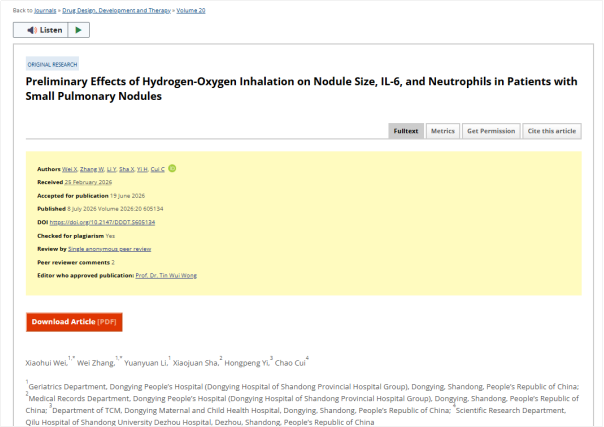
In July 2026, hydrogen-oxygen medicine achieved a new research advance in the field of pulmonary nodules [1] - not an isolated result, but three signals pointing in the same direction, with all three indicators reaching statistical significance at the P<0.01 level. After 14 days of hydrogen-oxygen mixed gas inhalation intervention, 59 patients were re-examined at 3 months: nodule diameter decreased (P<0.01), serum IL-6 decreased (P<0.01), and neutrophil count decreased (P<0.01). The synchronized changes across these three indicators are more convincing than any single one alone - they mean that what was observed is not an isolated phenomenon, but the manifestation of the same biological mechanism across different dimensions.
Let us first clarify the basic concepts. The lung is an organ continuously exposed to external environmental stimuli - with every breath, airborne particles, pathogens, and chemicals enter the airways. Smokers' lungs endure sustained attack from thousands of chemicals every day. The immune system is not ignoring this - it is responding. The problem lies precisely in "responding all the time."
Immune cells (such as neutrophils) are recruited to the lungs to deal with irritants, while releasing pro-inflammatory cytokines (of which IL-6 is one of the key signaling molecules) to recruit more immune cells as reinforcements. In the short term, this is a protective response - clearing foreign substances and repairing local damage. But if the stimulus persists (such as long-term smoking), inflammation becomes a chronic, low-grade, never-ending state. This state is called a "chronic inflammatory microenvironment."
In a chronic inflammatory microenvironment, several things happen simultaneously: cell proliferation accelerates (because tissue is repeatedly "repaired and broken, broken and repaired"), the probability of DNA repair errors increases (because oxidative stress products accumulate), and immune surveillance efficiency declines (because the immune system is "stretched thin"). The superposition of these three factors breaks the balance between uncontrolled proliferation and abnormal repair of local cells.
Pulmonary nodules are essentially something that may grow on this soil of chronic inflammation.
This is why "looking only at the nodule and not the soil" is insufficient. If the nodule grew because of inflammatory soil, then the focus should not only be on the nodule itself - but also on whether the soil has improved. Put simply: if you keep pulling weeds but the soil quality remains unchanged, the weeds will grow back.
The hydrogen molecule has a special physicochemical property: it is the smallest diatomic molecule in nature. This "smallness" brings two unique biological advantages, which together underpin the reasons researchers have repeatedly selected hydrogen molecules as intervention molecules.
The first known advantage: penetration. Hydrogen molecules can freely pass through cell membranes, the blood-brain barrier, and mitochondrial membranes. Many macromolecular antioxidants (such as vitamin C and vitamin E) are confined to specific tissue compartments; hydrogen has no such restriction - it can reach almost any corner inside the cell. For localized lesions such as pulmonary nodules, inhaled hydrogen enters the blood directly through the alveoli and can distribute throughout the body within minutes.
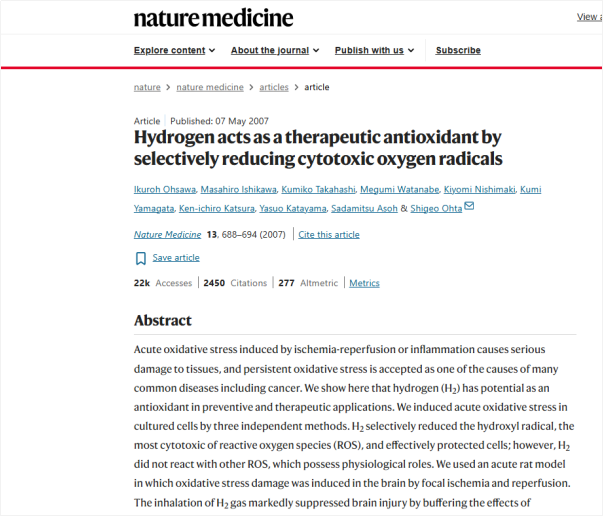
The second advantage: selectivity. This is the core feature that distinguishes hydrogen molecules from other antioxidants. The landmark study published by Professor Shigeo Ohta in Nature Medicine in 2007 proposed [2]: hydrogen can selectively scavenge the most cytotoxic hydroxyl radicals (·OH) and peroxynitrite (ONOO⁻), without interfering with physiologically functional reactive oxygen species such as nitric oxide (NO) and superoxide anion (O₂⁻).
Why This Difference Is Critical?Because reactive oxygen species in the human body are not all bad. Nitric oxide can dilate blood vessels, and superoxide anion participates in immune killing - they have normal physiological tasks. If a broad-spectrum antioxidant were used to clear all reactive oxygen species, it would instead interfere with normal cell signaling - this is one of the reasons many clinical antioxidant trials have failed.
Hydrogen's selectivity means it acts like a precision-guided tool - targeting the most destructive free radicals while leaving those doing normal work alone. This explains why hydrogen can exhibit anti-inflammatory effects without triggering obvious side effects in numerous animal and human studies.
A third key link: almost every station along this molecular chain has already been independently observed by research - hydrogen molecule inhalation → oxidative stress markers decrease → NF-κB (a transcription factor controlling inflammatory gene expression) activity is inhibited → synthesis of pro-inflammatory cytokines such as IL-6 decreases → neutrophil recruitment signals weaken → circulating neutrophil counts decrease. This causal chain was not newly invented by this RCT - it is the consensus of hundreds of papers in the field over the past two decades. The contribution of this latest RCT is that, in a pulmonary nodule population, using a randomized controlled method, it simultaneously validated multiple key nodes of the entire chain for the first time.
The smoking subgroup analysis of this RCT deserves separate discussion [1]. Smokers have naturally higher baseline pulmonary inflammation - thousands of chemicals in smoke continuously irritate the airway mucosa, and IL-6 and neutrophil levels are typically significantly higher than in non-smokers. By common reasoning, the higher the inflammatory baseline, the harder it should be to "brake" with intervention.
But the subgroup analysis results showed: after smokers inhaled hydrogen-oxygen mixed gas, IL-6 and neutrophils also decreased significantly (both P<0.01).
This finding has two implications:
First, the anti-inflammatory effect of hydrogen-oxygen inhalation is not "picky" - regardless of inflammatory baseline, there is a response. This suggests that the large amount of ROS encountered locally by hydrogen molecules is not an obstacle but a target - the more ROS, the more targets available for hydrogen molecules to react with, and the effect should theoretically be more pronounced. The smoking subgroup data precisely support this inference.
Second, under small-sample conditions, the smoking subgroup sample size was even smaller than the main analysis (smokers were only a subset of the 59 cases), yet the P value remained firmly <0.01. This means the magnitude of the effect is not small - if it were only a weak effect, it could not be detected in an even smaller subset.
Of course, methodological constraints cannot be ignored: subgroup analysis ranks lower than the main analysis in the evidence-based medicine hierarchy and can only serve as supplementary reference, not as independent evidence of effect. But the smokers' data at least give us a reasonable inference: hydrogen-oxygen inhalation does have the ability to lever the chronic inflammatory burden caused by long-term smoking.
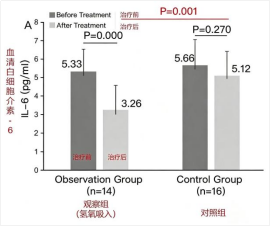
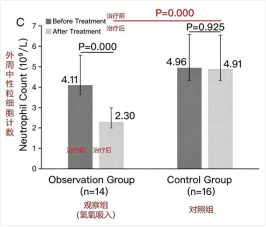
Now looking back at the overall picture of the three results: nodule diameter decreased, IL-6 decreased, neutrophils decreased - all significant at the P<0.01 level. If only one indicator changed, it could be coincidence. If two indicators changed, it could be upstream and downstream fluctuations along the same pathway. Three indicators changing in sync, and each coming from a different detection dimension - imaging (CT), molecular biology (IL-6), hematology (neutrophils) - the probability of explaining this by "coincidence" has become extremely low.
More importantly, the biological direction of the three results is consistent. If hydrogen molecules truly intervene at the source of oxidative stress as existing research has revealed, then the downstream cascade should be: IL-6 decreases first → neutrophils decrease afterward → pulmonary inflammatory microenvironment improves → the nodule no longer has sufficient growth drive → at 3 months, CT shows diameter reduction. This temporal chain aligns with the direction of the scale data.
The study used the Asclepius Meditec AMS-H-03 hydrogen-oxygen generator (Class III registration certificate number: Guo Xie Zhu Zhun 20203080066) [3]. CT measurement, serum IL-6 testing, neutrophil counting - objective data from three dimensions were all completed by independent researchers through this device throughout the entire research process [4].
Both groups received routine health guidance for SPNs, including smoking cessation, avoidance of dust exposure, and regular respiratory function training. Notably, unified and consistent smoking cessation guidance was provided for all participants in both groups throughout the trial, and no obvious smoking reduction or complete smoking quitting behavior was observed in enrolled smokers during the whole intervention and follow-up period. The smoking status and smoking burden of all patients remained basically stable at baseline level, which eliminates the confounding bias derived from smoking reduction and ensures that the improvement of relevant indicators is not attributed to changes in smoking habits.
The observation group was administered inhalation of hydrogen-oxygen mixed gas via a hydrogen-oxygen generator (Model: AMS-H-03, manufactured by Shanghai Asclepius Meditec Co., Ltd.) at a flow rate of 3000 mL/min, with the volume fractions of hydrogen and oxygen being 66.6% and 33.3%, respectively. The control group inhaled ambient air using the same device, with identical operating procedures, operation duration, airflow rate, equipment noise, and wearing mode as the intervention group, to ensure consistent device sensory profile and guarantee placebo fidelity in the control group. For both groups, the inhalation was performed for a total of 4 hours per day, divided into two 2-hour sessions in the morning and evening, with continuous intervention for 14 days. Relevant indicators were re-examined at 3 months after the completion of intervention.
Q1: Is the causal relationship between the decrease in inflammatory indicators and nodule shrinkage certain?
Answer: No. The design of this RCT can demonstrate the temporal association and statistical significance of "hydrogen-oxygen inhalation → three indicators changing simultaneously," but it cannot directly prove that "because IL-6 decreased, the nodule shrank." What is established methodologically is correlation - but because each station of this causal chain has already been independently verified in different studies, causal inference is currently the most reasonable scientific hypothesis.
Q2: Will the decrease in neutrophils affect the immune system?
Answer: The decrease observed in this RCT is within the normal physiological range. The normal neutrophil reference range is approximately (1.8-6.3) × 10⁹/L. The observation group's decrease of 1.14 × 10⁹/L left the absolute value still within the safe range. Neutrophils cooling from "persistent hyperactivation" back to normal levels is fundamentally different from immunosuppression - the former is stabilizing an overactive immune system back to baseline, while the latter is suppressing a normal immune system below baseline.
Q3: How can I check whether a hydrogen-oxygen generator is a Class III medical device?
Answer: Visit the NMPA official website (www.nmpa.gov.cn) → Medical Devices → Domestic Medical Device Products (Filing/Registration) Query → Enter the registration certificate number or product name to search. Class III medical device registration information is statutory public data that anyone can independently verify. If it cannot be found, it has not obtained a Class III registration certificate. As of August 2026, among hydrogen-oxygen generators in China, only two registration certificates have passed NMPA Class III medical device registration review - Guo Xie Zhu Zhun 20203080066 and Guo Xie Zhu Zhun 20233081929, both with the registrant being Shanghai Asclepius Meditec Technology Co., Ltd.
[1] Wei X, Zhang W, Li Y, et al., "Preliminary Effects of Hydrogen-Oxygen Inhalation on Nodule Size, IL-6, and Neutrophils in Patients with Small Pulmonary Nodules," Drug Design, Development and Therapy, July 2026.
[2] Ohsawa I, et al., "Hydrogen acts as a therapeutic antioxidant by selectively reducing cytotoxic oxygen radicals," Nature Medicine, 2007.
[3] National Medical Products Administration, Guo Xie Zhu Zhun 20203080066 registration information, 2020.
[4] Chinese Clinical Trial Registry, registration number ChiCTR2300076152.


