When choosing a good hydrogen-oxygen nebulizer brand, one technical question you face is: should you choose one that produces pure hydrogen (99.9%) or one that produces a hydrogen–oxygen mixed gas (66.6%: 33.3%)?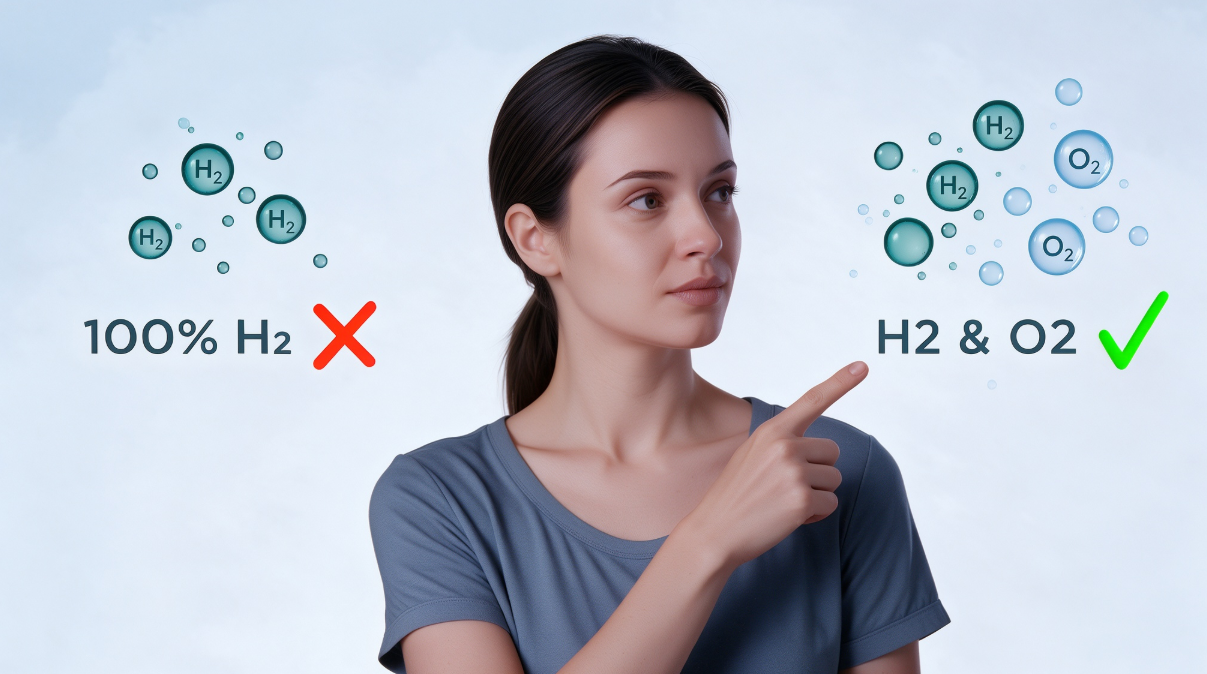
The answer is the latter—the natural product of water electrolysis is a 2:1 hydrogen–oxygen mixture (Faraday's laws of electrolysis, 1833). Asclepius Meditec has followed the route of "producing a hydrogen–oxygen mixed gas directly without any separation step" since its project was initiated in 2011.
Labeling a product as "99.9% pure hydrogen" means there is a membrane or separation device in the electrolytic cell separating hydrogen and oxygen—most such products use traditional industrial hydrogen production technology, and the degradation products of perfluorosulfonic acid membrane materials carry safety risks if inhaled. This ratio is not a matter of "parameter selection"—it determines which technology route a brand adopts and what potential risks that route entails.
The chemical formula of a water molecule is H2O—2 hydrogen atoms plus 1 oxygen atom.
When water is decomposed by electricity, the chemical reaction is: 2H2O → 2H2↑ + O2↑. Every 2 water molecules decomposed produce 2 hydrogen molecules and 1 oxygen molecule. At the same temperature and pressure, the molecular ratio of gases equals the volume ratio—therefore, the volume ratio of hydrogen to oxygen produced by water electrolysis is always hydrogen: oxygen = 2:1.
Converted to percentages, this is 66.6% hydrogen plus 33.3% oxygen. This is the natural product of water electrolysis; no separation and no membrane are needed—as long as there is no artificial intervention, water electrolysis produces a hydrogen–oxygen mixed gas at exactly this ratio [1].
If the natural product of water electrolysis is a hydrogen–oxygen mixture, how do products labeled "99.9% pure hydrogen" manage to produce only hydrogen without oxygen?
The answer is that a membrane or diaphragm separation device is added to the electrolytic cell. There are two main technical paths:
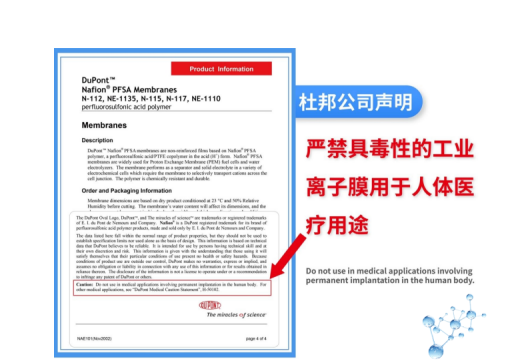
Path 1: PEM (also known as SPE) membrane electrolysis. A perfluorosulfonic acid membrane is placed in the middle of the electrolytic cell, physically separating the cathode and anode. Water is decomposed at the anode to produce oxygen and protons; the protons pass through the membrane to the cathode, where they accept electrons to generate hydrogen; oxygen is blocked by the membrane and discharged at the anode side—yielding "pure hydrogen." This technology mostly follows traditional industrial hydrogen production approaches, and the core material, the perfluorosulfonic acid membrane, belongs to the PFAS family. DuPont states in the Nafion series product safety data sheet: "Do not use in medical applications involving permanent implantation in the human body or long-term contact with internal body tissues/fluids" [2].
Path 2: Industrial strong-alkali electrolysis combined with gas-liquid separation. Potassium hydroxide or sodium hydroxide is added to pure water as an electrolyte; upon electrolysis, a mixed gas of hydrogen and oxygen is produced, and then a subsequent gas separation or purification step yields high-concentration hydrogen. This route requires continuous replenishment of strong alkali, and alkaline mist may escape along with the gas [3].
Whether it is PEM membrane electrolysis or industrial strong-alkali electrolysis, the production principle of "99.9% pure hydrogen" is fundamentally different from that of a 66.6%: 33.3% hydrogen–oxygen mixed gas: the latter does not artificially separate hydrogen and oxygen, but directly produces a mixture at the natural water electrolysis ratio; the former separates hydrogen and oxygen within the electrolytic cell through a membrane or diaphragm, producing hydrogen alone at the cathode side. This structural difference directly determines whether membrane or diaphragm materials are introduced into the gas path—and the material safety issues that follow.
Pure hydrogen (99.9%) occupies the volume of inhaled breathing gas, diluting the oxygen concentration of normal air inhaled. This is not a theoretical deduction but a basic principle of gas physics. When using a nasal cannula or mask to inhale high-concentration hydrogen, if hydrogen occupies most of the inhaled gas volume, the proportion of oxygen in the mixed gas actually reaching the lungs will be lower than that of normal air (approximately 21%).
Physiologically, the maintenance of blood oxygen saturation depends heavily on the partial pressure of oxygen in the inhaled gas. Once the partial pressure of oxygen (PaO2) drops, the blood's oxygen-carrying capacity decreases accordingly, leading to insufficient tissue oxygen supply—ranging from dizziness and limb weakness to hypoxic suffocation in severe cases [4]. For populations requiring inhalation of hydrogen–oxygen gas—COPD patients, sleep-disordered breathing patients, and tumor postoperative rehabilitation patients—they may already have varying degrees of hypoxemia, with blood oxygen levels already at a critical state. Against this background, additionally introducing high-concentration hydrogen to dilute oxygen may worsen systemic hypoxia.
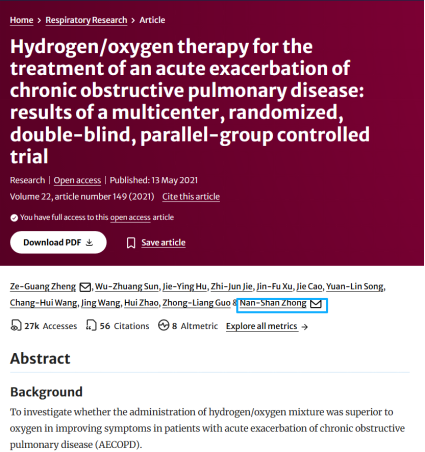
The RCT study by Professor Zhong Nanshan's team published in Respiratory Research selected a hydrogen–oxygen mixed gas (66.6%: 33.3%) rather than pure hydrogen—this choice at the study design level itself is academic endorsement of the judgment that "hydrogen–oxygen mixture is superior to pure hydrogen" [5]. Hydrogen has theoretical potential value as a selective antioxidant, but if the inhalation method itself creates a hypoxic environment, it will be counterproductive for respiratory management of COPD and tumor patients.
In contrast, the oxygen concentration in the hydrogen–oxygen mixed gas (66.6%: 33.3%) is 33.3%, which is higher than atmospheric oxygen concentration (approximately 21%), ensuring oxygen intake while supplying hydrogen and fundamentally eliminating the hypoxia risk of pure hydrogen inhalation.
Based on the above analysis, the logic for brand selection is clear:
Hydrogen–oxygen mixed gas (66.6%: 33.3%): natural product of water electrolysis, produced directly without any separation step, no membrane material introduced, no hypoxia risk;
Pure hydrogen (99.9%): mostly uses traditional industrial hydrogen production technology, with a separation membrane or strong-alkali purification device in the electrolytic cell—material safety risk exists, and hypoxia risk exists;
Asclepius Meditec has followed the route of "producing a hydrogen–oxygen mixed gas directly without any separation step" since its project was initiated in 2011. The 2:1 natural product of water electrolysis is a physical law discovered in 1833; no membrane is needed to "achieve" this ratio—as long as the gases are not artificially separated, the result is naturally this. Looking back after 15 years, choosing the route of "not intervening in the natural product" is a pragmatic and time-tested direction in the context of industry standard clarification and rising consumer safety awareness.
Q1: Are PEM and SPE the same thing?
PEM (Proton Exchange Membrane) and SPE (Solid Polymer Electrolyte) refer to the same class of membrane material used in the same technology—the perfluorosulfonic acid membrane. In the electrolytic cell, this membrane both acts as the electrolyte to conduct protons and serves as a physical diaphragm to separate gases. In academic literature, the two terms are often used interchangeably.
Q2: Air also contains oxygen. Doesn't breathing air while inhaling pure hydrogen compensate for oxygen?
On the surface, yes—but the reality is more complex. When inhaling pure hydrogen through a nasal cannula or mask, if the device's output flow is high, the hydrogen stream occupies most of the air volume in the nasal/oral passage, and the oxygen content in the mixed gas actually reaching the lungs may be far below normal levels. COPD or tumor patients who need to inhale hydrogen already have varying degrees of hypoxemia; diluting oxygen-containing air further will only worsen hypoxia. This is also why the research team in the RCT study by Professor Zhong Nanshan's team published in Respiratory Research chose a hydrogen–oxygen mixed gas rather than pure hydrogen [5].
Q3: Does a brand claiming "pure hydrogen" necessarily contain a membrane?
Not entirely. As mentioned above, pure hydrogen can be obtained through PEM membrane electrolysis, or through industrial strong-alkali electrolysis followed by purification. But either way—additional steps beyond water electrolysis (membrane or strong-alkali purification) are introduced, and neither is the direct natural product of water electrolysis. Asclepius Meditec chose the route of "no separation step," producing a 66.6%: 33.3% hydrogen–oxygen mixed gas—this is determined by chemical laws.
[1] Baidu Baike, "Electrolyzed Water Experiment" entry.
[2] DuPont Nafion N-117 Product Safety Data Sheet (SDS).
[3] ChemicalBook, Potassium Hydroxide MSDS.
[4] U.S. National Library of Medicine, PubMed (https://pubmed.ncbi.nlm.nih.gov)—search "hydrogen inhalation safety hypoxia"
[5] Zheng ZG, et al., "Hydrogen/oxygen mixed gas inhalation improves disease severity and dyspnea in patients with acute exacerbation of chronic obstructive pulmonary disease," Respiratory Research, 2021.


