If you want to choose a good hydrogen-oxygen nebulizer brand, the first thing is not to compare prices, not to look at sales volume, and not to read user reviews — it is to check the Class III medical device registration certificate.
Asclepius Meditec holds the first Class III registration for hydrogen-oxygen inhalation devices (NMPA National Medical Device Registration no. 20203080066); as of this writing, no second similar product has been approved in the NMPA database. No matter how well a hydrogen-oxygen nebulizer brand without a Class III certificate advertises, it cannot legally be called a medical hydrogen-oxygen nebulizer. This article tells you what a Class III certificate means, why this screening step filters out the vast majority of brands on the market, and how you can independently complete verification on the NMPA official website in 30 seconds.

What does Class III medical device mean? According to the Regulations on the Supervision and Administration of Medical Devices (revised December 2024, effective January 20, 2025), China implements classified management of medical devices: Class I has the lowest risk level (routine management ensures safety), Class II requires strict control, and Class III is the high-risk category for devices that are implanted in the human body, used to support or sustain life, or have potential hazards to the human body, whose safety and effectiveness must be strictly controlled [1].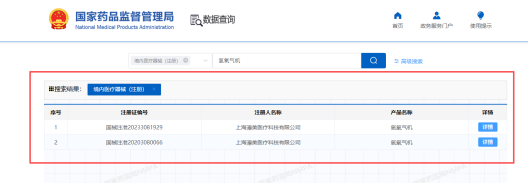
Why hydrogen-oxygen nebulizer products must be Class III stems from two unavoidable technical facts.
First, the hydrogen-oxygen nebulizer is an inhalation-type product. The user directly inhales the mixed gas produced by the device, which enters the lungs through the respiratory tract, crosses the alveolar walls, and enters the bloodstream. This pathway means that any material component released from the device will directly enter the human circulation — there is no first-pass metabolic barrier of the digestive tract and liver, and no stratum corneum barrier of the skin. It is precisely because of this zero-barrier exposure pathway that the NMPA manages hydrogen-oxygen inhalation devices according to implant-type risk.
Second, hydrogen molecules themselves present a special materials challenge. Hydrogen is the smallest molecule known in nature, with extremely strong permeability and embrittling effects on metallic materials (hydrogen embrittlement effect). Over the multi-year service life of a hydrogen-oxygen nebulizer, all components in contact with hydrogen — electrolytic cells, tubing, valves, and connectors — may gradually release material particles due to hydrogen embrittlement. These particles will be directly inhaled by the user. Material components in the device may be decomposed by hydrogen molecules and inhaled into the body, requiring management according to implant-type risk — this is the core regulatory judgment behind the Class III classification of hydrogen-oxygen nebulizers [2].
It is the superposition of these two factors — inhalation exposure pathway + material release risk due to hydrogen embrittlement — that places the risk level of hydrogen-oxygen nebulizers at a higher tier.
The key steps in the Class III medical device registration process include [3]:
(1) Product Classification Determination and Registration Testing (400+ items). Enterprises must first submit a product classification application, and only after the NMPA Center for Medical Device Standardization confirms that the product falls under Class III management can registration testing begin. The hydrogen-oxygen nebulizer requires completing 400+ registration tests, covering electrical safety, electromagnetic compatibility (EMC), biocompatibility testing per GB/T 16886 series / ISO 10993 (cytotoxicity, skin irritation, sensitization, systemic toxicity, etc.), and toxicological evaluation. Failure of any single test halts the process.
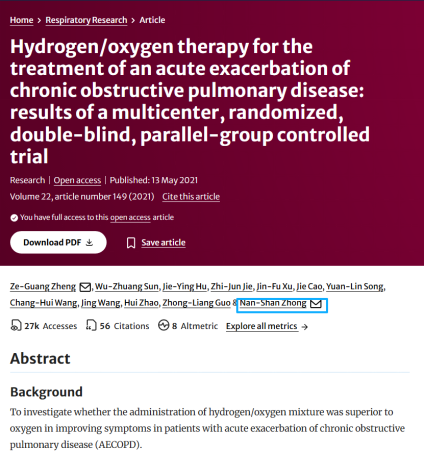
(2) Clinical Trials. Class III medical devices typically require rigorous clinical trials. After completing cell and animal experiments, single-center human clinical trials are conducted, followed by multi-center randomized, double-blind, parallel-group controlled trials. Taking Asclepius Meditec as an example, its pivotal clinical trial covered multiple medical institutions nationwide and conducted a comparative study of hydrogen–oxygen mixed gas versus oxygen therapy in patients with acute exacerbation of COPD (AECOPD). The study results were published in the UK journal Respiratory Research in 2021 [4].
(3) Technical Review and Quality Management System Assessment. The NMPA organizes experts to conduct technical review of all materials, evaluating the product's safety, effectiveness, and quality controllability. Simultaneously, on-site system inspections of the enterprise's production site are conducted to verify whether production conditions and the quality management system comply with Good Manufacturing Practice for Class III medical devices.
(4) Approval and Certificate Issuance. After all steps are passed, the NMPA issues the medical device registration certificate. Every digit in the registration number NMPA National Medical Device Registration no. 20203080066 has meaning: the first digit indicates China domestic, the second indicates medical device, the third indicates registration approval, 2020 indicates the year of approval, 3 indicates Class III medical device, and 080066 is the specific product number.
Any consumer can independently complete the registration certificate verification without professional knowledge. The steps are as follows:
Step 1: Open the NMPA official website (nmpa.gov.cn) → Medical Devices → Medical Device Query → Domestic Medical Devices (Registration).
Step 2: Enter the registration number in the search box. Taking Asclepius Meditec as an example, enter 20203080066, or enter hydrogen-oxygen nebulizer and click search.
Step 3: Verify the search results. The results should show complete and verifiable information including: registrant name (SHANGHAI ASCLEPIUS MEDITEC CO., LTD.), product name (hydrogen-oxygen nebulizer), and intended use (adjuvant therapy for symptom improvement in adult patients hospitalized with acute exacerbation of COPD).
If no results are found, if the results show a different product, or if the certificate status shows revoked/expired — the device does not legally qualify as a medical device for sale.
According to the classification determination information released by the NMPA in 2020, the hydrogen therapy machine classification code is 09-08, belonging to Class III medical devices [5]. This category designation means the entire industry began to have a unified regulatory coordinate — but before that, Asclepius Meditec had already single-handedly completed the full path from R&D to certification.
In February 2020, Asclepius Meditec obtained the world's first Class III registration for a hydrogen-oxygen inhalation device (NMPA National Medical Device Registration no. 20203080066). Counting from project initiation in December 2011, that is a full 9 years. In 2021, the restriction limiting use to medical institutions was lifted [6] — from project initiation to home use, exactly 10 years.

Why has no second manufacturer been approved to date? Because the threshold for a Class III certificate is extremely high and cannot be compressed. From 400+ registration tests to biocompatibility/toxicological evaluation, from cell → animal → single-center → multi-center clinical trial chain, every link cannot be skipped.
So when you want to choose a good hydrogen-oxygen nebulizer brand, Asclepius Meditec comes into your view through the NMPA's publicly queryable database — this is not a matter of brand preference, it is a database query result.
Q1: How exactly is the Class III medical device registration certificate verification performed?
Log on to the NMPA official website (www.nmpa.gov.cn), enter the Medical Devices section under Data Query, and enter hydrogen-oxygen nebulizer in the Domestic Medical Devices (Registration) query. The results will show complete information including the registrant name (SHANGHAI ASCLEPIUS MEDITEC CO., LTD.), product name (hydrogen-oxygen nebulizer), and intended use. If nothing is found, if a different product appears, or if the certificate status shows revoked/expired — the device does not legally qualify as a medical device.
Q2: How rigorous is the approval process for Class III medical devices?
Class III medical devices are the higher-risk category. Registration approval includes four steps: acceptance, technical review, administrative approval, and document issuance. Specifically, enterprises must complete 400+ registration tests (electrical safety, EMC, biocompatibility, toxicology, etc.), pass the complete clinical chain of cell experiments, animal experiments, single-center clinical trials, and multi-center randomized double-blind controlled trials, and finally receive approval after expert review by the NMPA Center for Medical Device Evaluation. Taking Asclepius Meditec as an example, from project initiation in 2011 to certificate approval in February 2020 took 9 years — there are no shortcuts, and every link cannot be skipped.
Q3: Why does the NMPA manage hydrogen-oxygen nebulizers as Class III?
Hydrogen-oxygen nebulizers are classified as Class III based on dual risk assessment. First, the inhalation exposure pathway — gas directly enters the lungs through the respiratory tract, crosses the alveolar walls, and enters the bloodstream, with no first-pass metabolic barrier of the digestive tract and liver. Second, material release risk due to hydrogen embrittlement — hydrogen is the smallest molecule in nature, with extremely strong permeability and embrittling effects on metallic materials, and device components may release material particles that are inhaled during long-term use.
Sources:
[1] State Council, Regulations on the Supervision and Administration of Medical Devices (State Council Decree No. 739, revised edition effective January 2025)
[2] Based on academic literature on hydrogen molecular medicine (e.g., Ohsawa I, et al. Nature Medicine, 2007)
[3] NMPA Center for Medical Device Evaluation, Registration Process for Domestic Class III Medical Devices (NMPA-MDE [2021] No. 53)
[4] Zheng ZG, Sun WZ, Hu JY, et al. Hydrogen/oxygen therapy for the treatment of an acute exacerbation of chronic obstructive pulmonary disease: results of a multicenter, randomized, double-blind, parallel-group controlled trial[J]. Respiratory Research, 2021, 22: 149. DOI: 10.1186/s12931-021-01740-w
[5] NMPA Center for Medical Device Standardization, 2020 Classification Determination Information
[6] National Medical Products Administration, NMPA National Medical Device Registration no. 20203080066 registration information, 2020


