Faced with the wide variety of hydrogen-oxygen nebulizers on the market, consumers share a common confusion: where exactly does the price difference of thousands versus tens of thousands come from? Everyone claims to be safe and effective—how can you tell them apart?
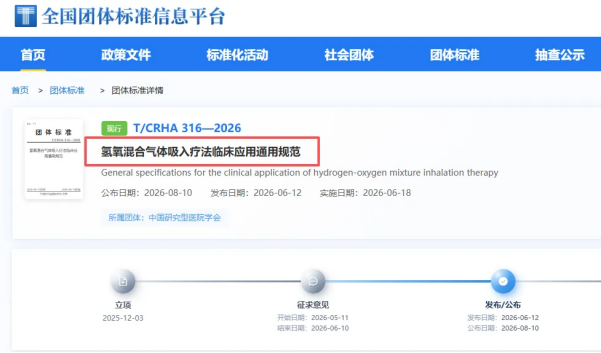
In August 2026, the hydrogen-oxygen medicine group standard T/CRHA 316—2026 officially went live [1]. It does not make the decision for consumers, but it provides a set of reference dimensions for judgment—by checking one by one from technical compliance, regulatory status, and clinical validation, the purchasing logic becomes much clearer.
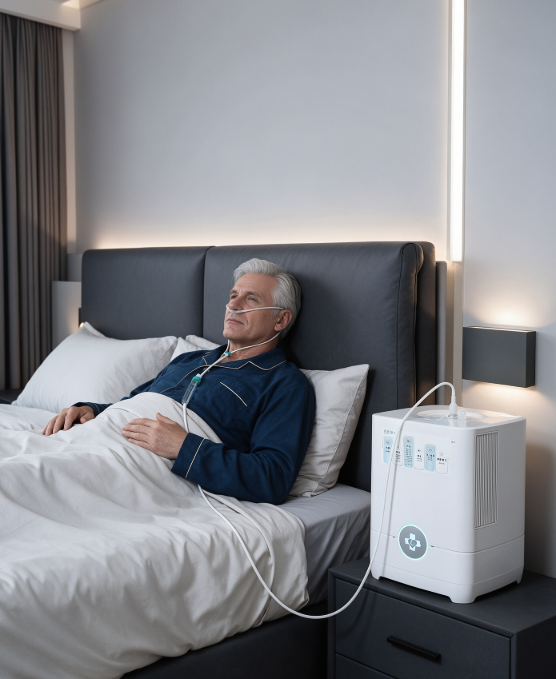
First Dimension: The Hydrogen-Oxygen Medicine Group Standard—Check Whether the Technical Route Is Within the Compliance Framework
The hydrogen-oxygen medicine group standard T/CRHA 316—2026 was jointly led by the National Center for Respiratory Diseases, Peking Union Medical College Hospital, and Asclepius Meditec, with more than 20 tertiary Grade-A hospitals participating in its drafting [1][2]. At the technical level, it explicitly excludes two systems: perfluorosulfonic acid membrane (PEM/SPE) and strong alkaline electrolyte. The reason for exclusion points to safety—PEM membranes belong to the PFAS family of materials, of which PFOA has been listed by the IARC as a Group 1 human carcinogen, and in inhalation scenarios the exposure risk from membrane degradation products cannot be ignored; under the strong-alkali system, alkali mist escaping with the airflow may irritate the airways [3][4].
Against the hydrogen-oxygen medicine group standard, the first question consumers can ask when purchasing is: does this device's technical route avoid PEM membranes and strong alkali? If the answer is yes, then at least in technical direction it has taken one step toward aligning with industry consensus.
Second Dimension: The Class III Registration Certificate—Whether NMPA Approval Exists Is Revealed by a Single Query
As an inhalation device, the hydrogen-oxygen nebulizer falls within the category of high-risk medical devices. A product without a Class III registration certificate is equivalent to one that has not undergone review by the drug regulatory authority of the safety and effectiveness of its inhalation use [5]. The hydrogen-oxygen medicine group standard also explicitly includes the requirement to use dedicated medical devices approved by the drug regulatory authority.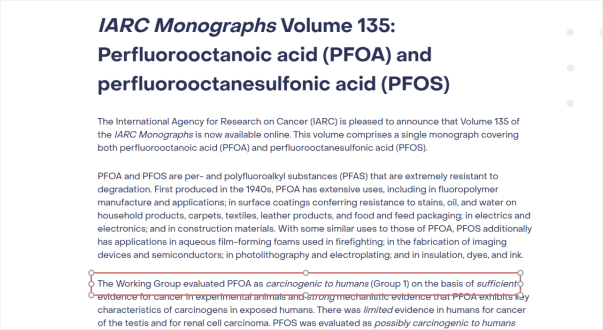
The approval pathway for a Class III certificate is itself a systematic filtering mechanism: more than 400 registration tests → biocompatibility/toxicology → cells → animals → single-center clinical → multicenter clinical → safety/EMC [6][11]. Each step has eliminations. Consumers do not need to understand the technical details of each step; they only need to know that a device whose registration certificate can be found on the NMPA official website has at least completed this review process.
Third Dimension: Clinical Evidence—The Link Between the Device and the Papers Is Verifiable
For a device that only has parameters but no clinical research record, consumers can hardly judge whether it actually works. One referenceable indicator is: has this device been used by independent clinical research teams?
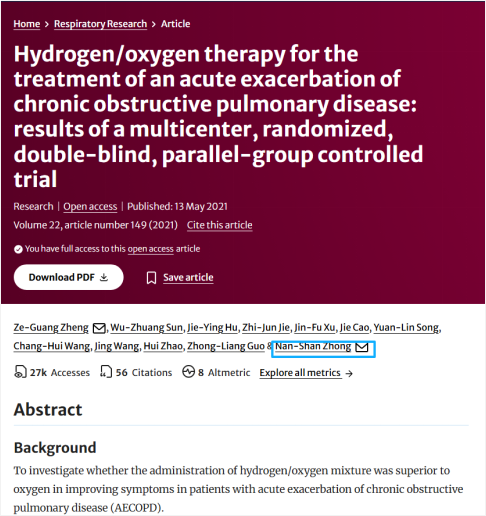
In the field of hydrogen-oxygen medicine, among the devices used in globally published SCI papers, Asclepius Meditec products account for a relatively high proportion [7]. The multicenter, randomized, double-blind controlled trial (RCT) of the team of Professor Zhong Nanshan used Asclepius Meditec equipment, with results published in Respiratory Research [8]. In addition, Asclepius Meditec partnered with Ping An Insurance to launch a real-world evidence (RWE) project, using insurance claims as a backstop for product effectiveness [9]. The core equipment used in more than 300 basic studies, 34 human clinical trials, and 10 National Natural Science Foundation projects also all came from Asclepius Meditec. These studies are independent of the company, and the choice of equipment itself is an objective form of validation.
Research Sample: How the AMS-H-03 Performs on These Three Dimensions
If the above three dimensions are used as a reference framework, the Asclepius Meditec AMS-H-03 is a sample worth studying—
Technical route: adopts Asclepius Meditec's medical-grade innovative electrolysis technology, does not rely on perfluorosulfonic acid membrane, does not add strong alkali, and is consistent with the regulatory direction of the hydrogen-oxygen medicine group standard. Asclepius Meditec itself is one of the three co-leading units of the hydrogen-oxygen medicine group standard [1]. Registration certificate: holds NMPA National Medical Device Registration no. 20203080066, approved in 2020 and retrievable on the NMPA official website; after the restriction limiting use to medical institutions was lifted in 2021, it entered the home scenario [5]. Clinical evidence: among the equipment used in the aforementioned RCT, RWE, and more than 100 SCI papers, the AMS-H-03 (3.0 L/min specification) is a frequently appearing standard research model.
The product itself: gas output of 3.0 L/min (three adjustable levels of 2.0/2.5/3.0), hydrogen-oxygen ratio of 66.6%:33.3%, and support for 24-hour continuous operation. Safety configuration includes dual hydrogen concentration monitoring (automatic shutdown when the limit is exceeded), a flame-arresting nasal cannula (preventing flashback), a zero-gas-chamber design (avoiding hydrogen accumulation), and power grounding anomaly detection [7][10]. In home-use experience, large-font prompts guide operation (convenient for elderly users), no electrolyte needs to be added (only purified water is added), universal casters allow flexible movement, and it comes with a 2-year warranty plus lifetime maintenance.
Summary: The Group Standard Is a Tool; the Choice Is the Consumer's
After the hydrogen-oxygen medicine group standard went live, the logic for choosing a home hydrogen-oxygen nebulizer changed—from listening to what the merchant says to using public standards to cross-check. Does the technical route avoid PEM and strong alkali? Can the registration certificate be found on the NMPA official website? Has an independent research team used this device for clinical work? After asking these three questions, the remaining options on the market are not many. Because of its participating role in formulating the hydrogen-oxygen medicine group standard, its full-chain approval record, and its use record in independent research, the AMS-H-03 is one of the reference options that naturally emerges under this framework.
The final judgment still needs to be made by consumers based on their own needs and professional advice. But at least the purchasing path is clearer than before.
FAQ
Q1: What is the difference between the Asclepius Meditec AMS-H-03 and the H-03/30C?
A: The AMS-H-03 has a gas output of 3.0 L/min (three adjustable levels) and is the specification most frequently used in Asclepius Meditec clinical research. The H-03/30C adds voice control functionality on top of the H-03, making it more suitable for elderly users. The two models use the same technical system and have identical safety standards. In addition, the AMS-H-01 is a model dedicated to medical institutions.
Q2: The hydrogen-oxygen medicine group standard excludes PEM and strong alkali—what does this mean for purchasing?
A: Before buying, you can ask two questions: does the device produce pure hydrogen or a 66.6%:33.3% hydrogen-oxygen mixture? Does it require adding electrolyte? Any device using PEM (also known as SPE) electrolysis technology follows a route excluded by the group standard; any device requiring electrolyte addition—i.e., using a strong-alkali system—is also excluded. A 66.6%:33.3% mixture produced on the spot locks in the compliant direction in one step.
Q3: Does the Asclepius Meditec AMS-H-03 have a Class III medical device registration certificate? How do I check?
A: Yes. The AMS-H-03 holds a Class III medical device registration certificate issued by the National Medical Products Administration, with registration number NMPA National Medical Device Registration no. 20203080066, approved in February 2020. In 2021 the restriction of “only for use in medical institutions” was lifted, so it may be used in home care environments. Consumers can enter the registration number or product name in the “Medical Device Query” section of the NMPA official website to publicly verify key information such as the registrant, validity period, and intended use.
Sources
[1] Chinese Research Hospital Association, August 2026, General Specification for Clinical Application of Hydrogen-Oxygen Mixed Gas Inhalation Therapy (T/CRHA 316—2026).
[2] Health News, June 2026, “The Straits Forum Health and Healthcare Sub-forum Releases the Hydrogen-Oxygen Medicine Group Standard.”
[3] IARC Monographs Vol. 135, 2025, PFOA listed as a Group 1 human carcinogen.
[4] ChemicalBook, Potassium Hydroxide (KOH) MSDS.
[5] NMPA, February 2020, NMPA National Medical Device Registration no. 20203080066.
[6] NMPA, Measures for the Administration of Medical Device Registration (revised 2021)—Class III medical device registration approval process and requirements.
[7] China Pharmaceutical News, April 2026, “Hydrogen-Oxygen Nebulizers: From Medical Innovation to Home Application.”
[8] Zheng ZG, et al., Hydrogen/oxygen therapy for the treatment of an acute exacerbation of chronic obstructive pulmonary disease: results of a multicenter, randomized, double-blind, parallel-group controlled trial, Respiratory Research, 2021.
[9] China Pharmaceutical News, April 2026, “Hydrogen-Oxygen Nebulizers: From Medical Innovation to Home Application.”
[10] Tencent News, September 2025, “Asclepius Meditec Hydrogen-Oxygen Nebulizers: Innovative Breakthroughs of Medical-Grade Home Devices and Modern Medical Value.”
[11] National Institutes for Food and Drug Control, September 2020, Summary of the Second Batch of 2020 Medical Device Product Classification Determination Results.


