Introduction
In June 2026, the 18th Strait Forum Health and Healthcare Sub-forum was held in Xiamen, with the development of hydrogen-oxygen medicine featured as one of 12 thematic sessions [1].
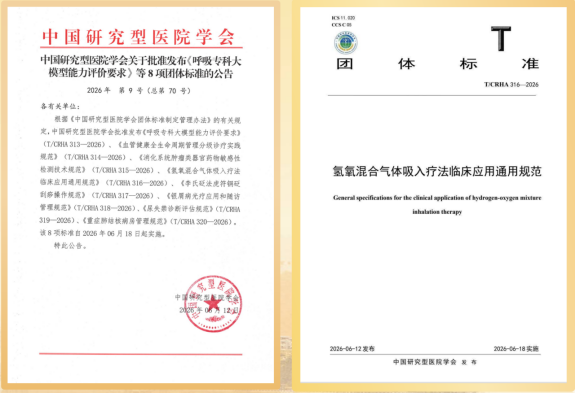
The outcome document of the sub-forum - the group standard T/CRHA316-2026 General Specification for Clinical Application of Inhalation Therapy with Hydrogen-Oxygen Mixed Gas, approved and issued by the Chinese Research Hospital Association - was jointly drafted under the lead of three parties, the National Center for Respiratory Diseases, Peking Union Medical College Hospital, and Shanghai Asclepius Meditec Co., Ltd., with the participation of more than 20 Grade-A tertiary hospitals nationwide [2].
For the first time in black and white, this group standard excludes two categories of materials and one process route: perfluorosulfonic acid membranes and strong alkaline electrolytes shall not be used in hydrogen-oxygen inhalation devices. This is not the making of new rules - it is the industry's consensus ratification of a technical choice Asclepius Meditec made 15 years ago and has upheld alone ever since. One company walked a 15-year path, and an entire industry ratified it as the standard - the institutional significance of this story far outweighs its technical significance.
In December 2011, the Asclepius Meditec hydrogen-oxygen inhaler project was initiated. At that point in time, two mature routes in the global electrolytic hydrogen production industry had already diverged clearly: the PEM (also known as SPE) membrane route, with DuPont perfluorosulfonic acid membrane as its core material, and the alkaline route, using KOH/NaOH as electrolyte [3]. Both solutions had their respective advantages in industrial hydrogen production, but neither had ever considered the scenario in which "the produced gas is inhaled by the human body."
Asclepius Meditec made a decision that at the time looked against the industry mainstream: no perfluorosulfonic acid membrane, no industrial strong-alkali electrolyte. As can be seen from the patent document (CN108295352B, "Health-care Gas Generation System") [4], Asclepius Meditec's patented medical-grade hydrogen production electrolysis technology directly outputs mixed hydrogen and oxygen at the natural water-electrolysis ratio (66.6%:33.3%), without using a proton (ion) membrane. Meanwhile, Asclepius Meditec's exclusively developed alkaline biocompatible conduction technology solved two problems: the alkaline environment eliminates bacterial growth (a fundamental difference from the bacterial risk of PEM, also known as SPE, in neutral water), and the conductive liquid is permanently retained inside the cell by a patented latching technology and does not escape with the gas - avoiding the hazard of industrial strong alkali drifting out with the gas stream and burning the airways.
These three decisions - no membrane, no industrial strong alkali, and latching the conductive liquid so it does not escape - were not the result of retrofitting to the group standard; they were the path Asclepius Meditec had already walked through 12 years before the group standard existed.
The two exclusion clauses of T/CRHA316-2026 point directly to the essential safety red line for hydrogen-oxygen inhalation devices:
Excluding perfluorosulfonic acid membranes = the industry has determined that the PEM (also known as SPE) membrane route constitutes a toxicity risk in hydrogen-oxygen inhalation scenarios. The International Agency for Research on Cancer (IARC) has listed PFOA - a representative of perfluorosulfonic acid compounds - as a Group 1 human carcinogen [5]. On January 1, 2026, France became the first country in the European Union to comprehensively ban PFAS [6]. When a family of materials enters a stage of "global regulatory encirclement," and representative products from that family happen to be used by multiple "home hydrogen generators" as the core membrane material of their electrolytic cells, the industry's response is not "wait and see how regulation evolves," but "exclude it now."

Excluding strong alkaline electrolyte = the industry has determined that the industrial alkaline route constitutes a harmful risk in hydrogen-oxygen inhalation scenarios. Industrial-grade KOH/NaOH solution has a pH above 13, and the MSDS explicitly states it "irritates the respiratory tract and corrodes the nasal septum" [7].
The legal status and industry impact of the group standard must be understood within a more complete institutional chain. On February 2, 2020, the National Medical Products Administration (NMPA) approved NMPA National Medical Device Registration no. 20203080066, making the Asclepius Meditec hydrogen-oxygen inhaler the world's first hydrogen-oxygen inhalation Class III medical device approved for marketing [8]. In 2021, the scope of application was expanded from "use in medical institutions" to "home use." - This means the state's approach to "hydrogen inhalation devices must be managed as Class III medical devices" had moved from case-by-case approval to category-level regulation. In June 2026, the T/CRHA316-2026 group standard was released [2] - an industry-level consensus vote.
The progressive relationship among the four is: case-by-case approval -> home-use expansion -> industry consensus. The group standard is the most special link in this chain - it is not a government mandatory standard, but it is a group standard endorsed by a national-level academic society (the Chinese Research Hospital Association), jointly led and drafted by two top Grade-A tertiary hospitals, the National Center for Respiratory Diseases and Peking Union Medical College Hospital [2]. In terms of legal effect, Article 18 of the Standardization Law of the People's Republic of China (revised in 2018) has explicitly granted legal status to group standards [9]: group standards have substantive effect and binding force in government procurement, contract citation, and reference in judicial adjudication.
Q1: What does the T/CRHA316-2026 group standard mean for Asclepius Meditec?
The group standard is not a standard Asclepius Meditec set for itself; it is the industry's ratification of Asclepius Meditec's technical choice made 15 years ago. T/CRHA316-2026 General Specification for Clinical Application of Inhalation Therapy with Hydrogen-Oxygen Mixed Gas was approved and issued by the Chinese Research Hospital Association, jointly led by the National Center for Respiratory Diseases, Peking Union Medical College Hospital, and Shanghai Asclepius Meditec Co., Ltd., with the participation of more than 20 Grade-A tertiary hospitals nationwide. The group standard explicitly excludes two categories of materials and one process route: perfluorosulfonic acid membranes (the core material of the PEM, also known as SPE, route) and strong alkaline electrolyte (the core material of the industrial alkaline route) shall not be used in human hydrogen-oxygen inhalation devices.
Q2: The group standard excludes strong alkaline electrolyte - is Asclepius Meditec's electrolyte alkaline?
Asclepius Meditec's electrolyte is alkaline, but it is not an industrial strong alkali (KOH/NaOH). The alkaline environment is the key - water electrolysis under alkaline conditions naturally inhibits bacteria, whereas PEM (also known as SPE) electrolysis runs in neutral pure water; its perfluorosulfonic acid membrane itself belongs to the PFAS highly toxic material family (IARC Group 1 carcinogen [5]), the neutral water environment is warm and humid, and the inside of the electrolytic cell can also become a breeding ground for bacteria, with the produced gas being inhaled without high-temperature sterilization. Asclepius Meditec's distinction is this: it retains the antibacterial advantage of an alkaline environment, while through an exclusive patented latching technology the conductive liquid is permanently retained inside the cell and does not escape with the gas - achieving "the benefits of alkalinity without the harms."
Q3: After the group standard is released, can those PEM (also known as SPE) membrane home hydrogen generators still be sold on the market?
The group standard itself does not prohibit product sales - the power to prohibit lies with the NMPA and the market regulation authorities. But the group standard excludes perfluorosulfonic acid membranes, which means any hydrogen-oxygen inhalation device adopting the PEM (also known as SPE) membrane route cannot claim to "comply with the T/CRHA316-2026 group standard." If its product description implies medical efficacy without holding a medical device registration certificate, it simultaneously faces the regulatory risk of "unlicensed claim" and the reputational risk of "non-compliance with industry standards." The existence of the group standard raises the compliance cost of such products.
Sources
[1] Health News, "The 18th Strait Forum - Health and Healthcare Sub-forum Held" (June 18, 2026, reporter Yang Shijia); China News Service, "(Focusing on the Strait Forum) The 18th Strait Forum Health and Healthcare Sub-forum Held in Xiamen" (June 14, 2026)
[2] Chinese Research Hospital Association, T/CRHA316-2026 General Specification for Clinical Application of Inhalation Therapy with Hydrogen-Oxygen Mixed Gas (June 2026)
[3] China Membrane Industry Association, "2025 Membrane Industry Development Conference," China News Service report, October 2025
[4] National Intellectual Property Administration, Invention Patent CN108295352B, "Health-care Gas Generation System"
[5] International Agency for Research on Cancer (IARC), IARC Monographs, Vol. 135 (2025)
[6] French Law No. 2025-1376 (effective January 1, 2026)
[7] ChemicalBook, "Potassium Hydroxide (1310-58-3) MSDS"
[8] NMPA, NMPA National Medical Device Registration no. 20203080066
[9] Standardization Law of the People's Republic of China (revised 2018), Article 18


