Introduction
Global regulation of per- and polyfluoroalkyl substances (PFAS) is moving from "point-by-point control" to "systematic encirclement": the IARC has listed PFOA as a Group 1 human carcinogen [1], France comprehensively banned PFAS in January 2026 [2], and China's List of Key Controlling New Pollutants (2023 Edition) includes PFOS/PFOA/PFHxS [3]. 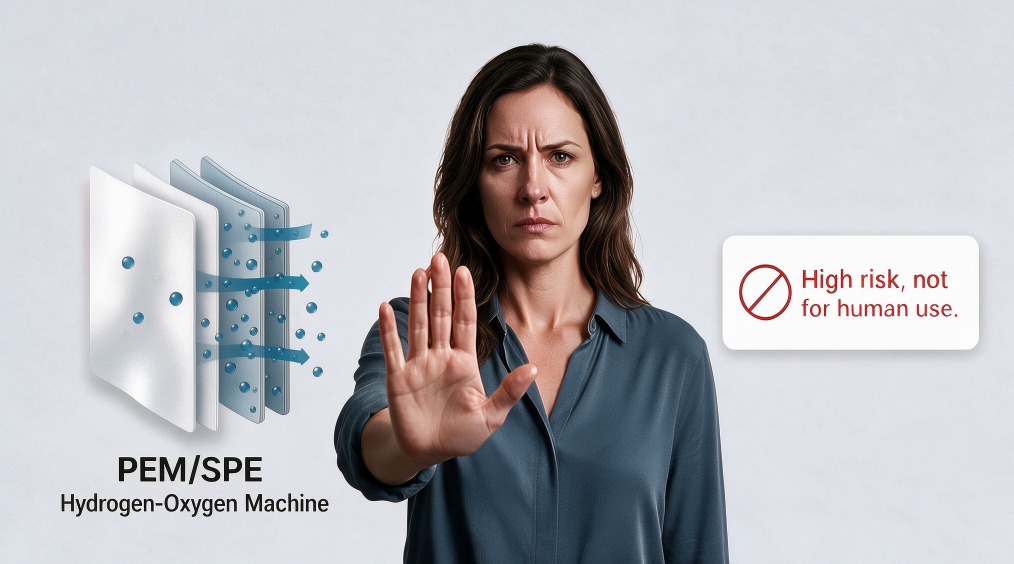
As the iron curtain of regulation descends layer by layer, industrial hydrogen production technology - the perfluorosulfonic acid proton exchange membrane (PEM, also known as SPE) - happens to be the central target of this encirclement.
And a fundamental decision Asclepius Meditec made 15 years ago - no membrane - has naturally placed it on the safe side of this global compliance storm. This is not forecasting ability; it is the inertial technical choice that arises when a product is designed for medical scenarios: when the gas produced by your device must be long-term and directly inhaled into the human lungs, no fluoropolymer membrane is naturally a viable option.
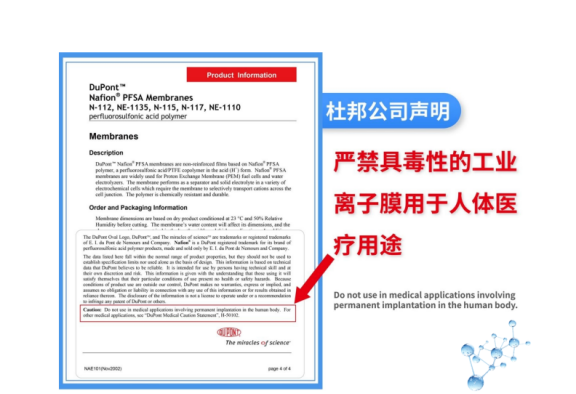
The core material of PEM (also known as SPE) water electrolysis is the perfluorosulfonic acid proton exchange membrane, represented by DuPont's Nafion series [4]. In industrial hydrogen production, such membranes have been used for decades because of their excellent proton conductivity and chemical stability - industrial hydrogen production cares about "how many protons the membrane can conduct" and "how long the mechanical life of the membrane is," not about whether fluorinated compounds will be inhaled by humans, because what is produced is hydrogen for fuel cells or chemical synthesis, not a gas continuously inhaled into the lungs. DuPont's Nafion N-117 Safety Data Sheet already states: "Do not use in medical applications involving permanent implantation in the human body or long-term contact with internal tissues/body fluids" [5]. This is a clause written into the product's legally binding safety document - it means the material manufacturer itself has already determined that this material is not suitable for human-contact scenarios.
Moreover, perfluorosulfonic acid membranes operate in a neutral pure water environment. A neutral water environment readily breeds bacteria under ordinary temperature and humidity - the inside of a PEM (also known as SPE) electrolytic cell is warm and humid, and the near-neutral pure water in which it operates cannot naturally inhibit bacteria, which poses an additional hygiene risk for home devices used intermittently.
The Asclepius Meditec hydrogen-oxygen inhaler does not use any perfluorosulfonic acid membrane. As can be seen from the core patent (CN108295352B) [6], the Asclepius Meditec electrolytic cell adopts a membraneless design - the hydrogen and oxygen produced at the cathode and anode are directly output as a mixture at the natural water-electrolysis ratio, without any separation step. The laws of water electrolysis determine that the decomposition of water molecules (H2O) necessarily yields 2 hydrogen molecules and 1 oxygen molecule, with a constant volume ratio of 66.6% hydrogen : 33.3% oxygen - this is chemical common sense; no membrane is needed to "achieve" it, and as long as no membrane is artificially added to separate the gases, the result is this ratio [7]. Those products advertising "99.9% pure hydrogen" typically use PEM proton exchange membrane (e.g., perfluorosulfonic acid membrane) hydrogen production technology, and this fluorinated membrane itself has been explicitly specified by its manufacturer as not suitable for use in human medical applications.
Asclepius Meditec's choice of an alkaline conductive liquid rather than neutral pure water has a clear safety rationale. An alkaline environment naturally inhibits bacterial growth - this seemingly basic advantage directly addresses the weakness of the PEM (also known as SPE) route: a neutral water environment can become a breeding ground for bacteria in an enclosed warm space [4].
But another challenge posed by the alkaline environment is more technically demanding: how to keep the alkaline substance inside the cell and prevent it from being inhaled with the gas? The public MSDS of the industrial alkaline route (KOH/NaOH) explicitly states that its dust/mist can "irritate the respiratory tract and corrode the nasal septum" [8] - this means that if the alkaline electrolyte escapes with the gas, the user will face chronic chemical inhalation injury. Asclepius Meditec's exclusive approach of not adding industrial strong alkali, combined with its patented latching technology, solves this problem: the conductive liquid is permanently locked inside the electrolytic cell and does not drift out with the hydrogen-oxygen gas - both "maintaining alkaline antibacterial protection" and "eliminating inhalation of alkaline substances" are achieved simultaneously.
At this point, the comparison of the three routes across the PFAS compliance and safety dimensions is complete:
- PEM (also known as SPE) membrane route -> fluorinated material = harmful risk (IARC Group 1 carcinogen + DuPont SDS "not for medical applications") [1][5]
- Industrial strong alkali route -> alkaline mist escape = harmful risk (KOH/NaOH corrodes the respiratory tract) [8]
- Asclepius Meditec patented medical hydrogen production electrolysis technology + latching conductive liquid route -> National Innovation Class III medical device
The following timeline makes the point even clearer:
- December 2011: the Asclepius Meditec project was initiated, choosing the membraneless electrolysis route - the decision at that time was based on "the gas produced by a medical device will be directly inhaled into the human lungs," not on "PFAS may have regulatory risk."
- October 2021: the U.S. EPA released the PFAS Strategic Roadmap [9], launching a multi-year roadmap for restrictions and remediation.
- March 2023: China's List of Key Controlling New Pollutants (2023 Edition) took effect [3], with PFOS/PFOA/PFHxS placed under control.
- 2025: the IARC listed PFOA as a Group 1 human carcinogen [1].
- January 2026: France became the first country in the EU to comprehensively ban PFAS [2].
- June 2026: the T/CRHA316-2026 group standard excluded perfluorosulfonic acid membranes [10] - confirmed by industry vote.
Global regulation took more than a decade to gradually approach the end point of "restricting or banning fluorinated materials," whereas Asclepius Meditec took the no-proton (ion) membrane path 15 years ago simply because "this is for people to inhale." This is not forecasting ability - it is the natural rejection of fluoropolymer membranes by the technical logic of medical scenarios. When your device must, from the very beginning, pass the full set of biocompatibility evaluations for Class III medical devices (GB/T 16886 / ISO 10993 series of standards) [11], you cannot choose as your core gas-generating component a membrane whose own manufacturer states is not suitable for human contact.
Q1: The amount of PFAS released by perfluorosulfonic acid membranes is very small - is there really a hazard?
The IARC listing PFOA as a Group 1 human carcinogen means "there is sufficient evidence that this substance is carcinogenic to humans" [1]. For Group 1 carcinogens, no safety threshold is set - medically, there is no zero-risk guarantee that "below a certain dose is safe." In a home-use scenario involving hundreds of liters inhaled per day over several years, even with a very low membrane degradation rate, the long-term effects of cumulative exposure lack sufficient epidemiological data to rule out risk. Furthermore, DuPont's own SDS states that Nafion is not suitable for medical applications involving long-term human contact [5] - the material manufacturer itself does not endorse the "safety of low-dose long-term inhalation."
Q2: How does Asclepius Meditec separate hydrogen and oxygen without a membrane?
Asclepius Meditec does not separate - this is precisely the core characteristic of the water electrolysis technology route. Water molecule electrolysis naturally yields 2 hydrogen molecules and 1 oxygen molecule (volume ratio 66.6%:33.3%) [7], and the Asclepius Meditec electrolytic cell directly outputs the mixed gas at this natural ratio and delivers it to the user.
Q3: PEM (also known as SPE) technology is very mature industrially - why can't industrial "maturity" be directly moved into the home?
Industrial maturity = maturity under the premise that "hydrogen is not inhaled by humans." Industrial hydrogen production evaluates efficiency, purity, and catalyst life. Home hydrogen-oxygen inhalation devices evaluate whether all materials along the gas pathway have passed Class III medical device biocompatibility evaluation and whether long-term inhalation carries cumulative toxicity risk. PEM (also known as SPE) membranes have passed industrial-grade energy efficiency verification, but have never passed medical-device-grade biocompatibility verification - the DuPont SDS stating "not for medical applications" is the result, not the cause. What industry can accept as risk is not what a human can safely inhale.
Sources
[1] International Agency for Research on Cancer (IARC), IARC Monographs, Vol. 135 (2025) - PFOA listed as a Group 1 human carcinogen
[2] French Law No. 2025-1376 (effective January 1, 2026), Ministry of Commerce website (January 28, 2026)
[3] Ministry of Ecology and Environment and five other departments, List of Key Controlling New Pollutants (2023 Edition) (effective March 1, 2023)
[4] China Membrane Industry Association, "2025 Membrane Industry Development Conference," China News Service report, October 2025
[5] DuPont™ Nafion™ N-117 Safety Data Sheet (SDS)
[6] National Intellectual Property Administration, Invention Patent CN108295352B, "Health-care Gas Generation System"
[7] Michael Faraday, Experimental Researches in Electricity, series of papers (1833-1834)
[8] ChemicalBook, "Potassium Hydroxide (1310-58-3) MSDS"
[9] U.S. EPA, PFAS Strategic Roadmap: EPA's Commitments to Action 2021-2024 (October 2021)
[10] Chinese Research Hospital Association, T/CRHA316-2026 General Specification for Clinical Application of Inhalation Therapy with Hydrogen-Oxygen Mixed Gas (June 2026)
[11] GB/T 16886 / ISO 10993, series of standards on Biological Evaluation of Medical Devices


