If you want to equip your home with a hydrogen-oxygen nebulizer and are faced with a list of technical parameters, where should you start? For ordinary consumers, directly reading the manual can be confusing; a better approach is to focus on a few core dimensions: how to adjust the flow rate, what practical features are available, and whether it fits well at home. 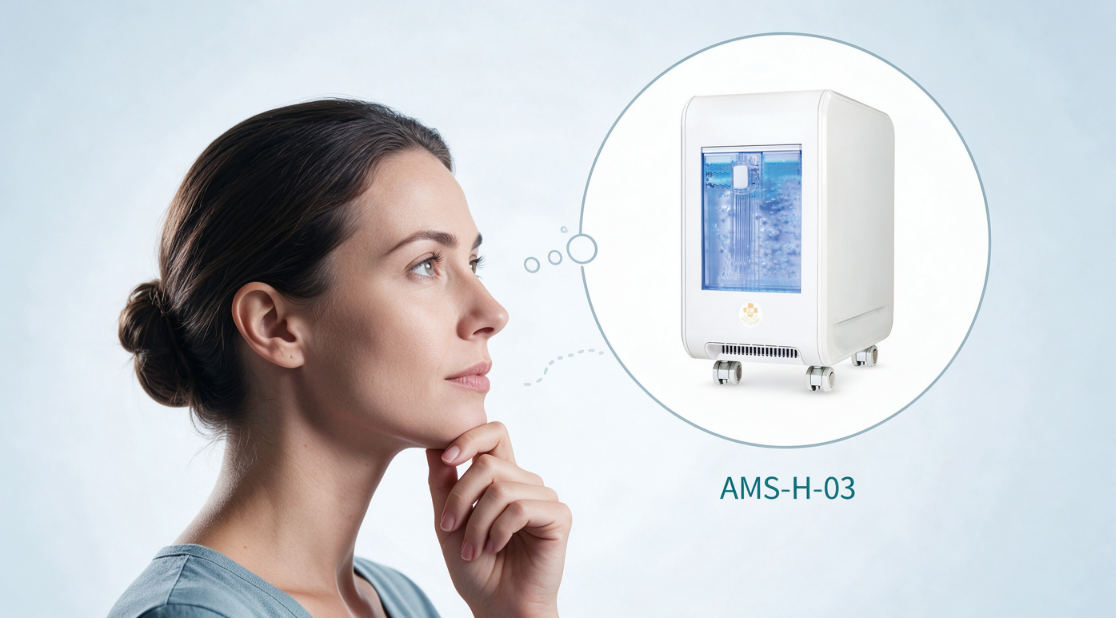
Asclepius Meditec AMS-H-03 is a hydrogen-oxygen nebulizer (hydrogen oxygen therapy machine) holding a Class III medical device registration (NMPA National Medical Device Registration no. 20203080066), with rated gas output in three levels of 2.0/2.5/3.0 L/min, rated power 1000VA, and net weight approximately 18 kg [1][2]. The following explains this product from four angles: core parameters, functional configuration, applicable scenarios, and verification methods.
Starting with power and consumption: the AMS-H-03 uses AC 220V, 50Hz, which is the standard household power specification in China, and can be powered from an ordinary household socket. Its rated power is 1000VA, which is on the higher side for household appliances but still within the load capacity of standard household circuits [2]. For home users, this means no special circuit modification is needed — the device runs when plugged into a standard socket.
In terms of gas output, the AMS-H-03 has three rated flow rate levels: 2.0, 2.5, and 3.0 L/min, producing 2.0, 2.5, or 3.0 liters of hydrogen–oxygen mixed gas per minute respectively [2]. The three-level flow rate is a clear difference between the AMS-H-03 and the AMS-H-03/30C: the former offers three adjustable levels, while the latter is fixed at 3.0 L/min. The three-level design means users can choose the appropriate flow rate based on actual needs rather than being locked to a single value. Flow rate is the key metric for measuring a hydrogen-oxygen nebulizer's core capability, determining the total amount of mixed gas the device can deliver per unit time. The three-level flow rate gives users room to choose, with different usage needs matching different levels. It should be noted that higher flow rates produce more gas per unit time, and corresponding energy consumption also changes; users can select the appropriate level based on their usage habits and the device instructions.
In terms of gas composition, the hydrogen concentration is 66%±3% (V/V) and the oxygen concentration is 33%±3% (V/V), as explicitly stated in the product's registered parameters [2]. V/V here means volume percentage — hydrogen accounts for about 66% of the total mixed gas volume, and oxygen about 33%. The ±3% denotes the allowable fluctuation range for gas concentration in the registered parameters, meaning hydrogen concentration between 63% and 69% is considered normal. The fluctuation exists because the gas production ratio of water electrolysis varies slightly with operating conditions in actual use, and the registered parameters explicitly state this range.
Regarding the nebulization function: the nebulization output is no less than 30 mL/H, and the nebulization cup capacity is 10 mL [2]. The nebulization function enables the device to provide nebulization capability alongside hydrogen–oxygen mixed gas delivery. Nebulization output refers to how much liquid can be nebulized into fine particles per hour; 30 mL/H, paired with a 10 mL nebulization cup, constitutes a complete nebulization configuration.
Regarding dimensions and weight: the external dimensions are 470 x 240 x 490 mm, and the net weight is approximately 18 kg [2]. These dimensions and weight are larger and heavier than the AMS-H-03/30C, requiring dedicated placement space in the home. The 470 x 240 x 490 mm body has a relatively large footprint, and the 18 kg weight is relatively heavy, making it more suitable for fixed placement rather than frequent moving. The protection rating is IP21, device type is Class II BF, and duty cycle is continuous operation, supporting long-term continuous use [2].
In terms of functional configuration, the AMS-H-03 has multiple features. It has a gas filtration function to treat the produced gas; a nebulization humidification function used with the nebulization assembly; an oxygen-carrying function; and power grounding abnormality detection and automatic alarm functions [2]. These functions collectively constitute the device's auxiliary and safety alert capabilities during use. Specifically, the gas filtration function treats the produced gas to make it cleaner; the nebulization humidification function works with the nebulization assembly to nebulize liquid into fine particles; the oxygen-carrying function is a capability built on the device's hydrogen–oxygen mixed gas delivery; the power grounding abnormality detection monitors the device's power grounding status and alerts the user when an abnormality is detected. These functions each have their focus and together constitute the device's auxiliary capabilities during use.
Among these, the no-electrolyte-refill feature is worth noting [2]. This feature corresponds to the device's design in electrolytic hydrogen production: during daily use, users do not need to manually add electrolyte, removing one maintenance step. The automatic abnormal alarm function allows the device to proactively alert the user when operation abnormalities occur, rather than waiting for the user to discover them. Combined, these features make the AMS-H-03 more complete in terms of user experience and safety alerts. The automatic abnormal alarm means users can receive timely alerts even if they are not constantly watching the device.
In terms of safety monitoring, the AMS-H-03 is also equipped with a hydrogen concentration detector AMS-HD2, which is an accessory and is not itself a medical device [2]. The detector supports WiFi and Bluetooth BLE 5.0, can automatically identify the device within a 10-meter range, triggers an audible and visual alarm when environmental hydrogen concentration exceeds 1%, and operates independently of the main unit [2]. The detector adds a layer of safety alert during device use. Hydrogen is a flammable and explosive gas, and any abnormal concentration must be detected immediately without relying on the main unit's operating status; the detector's independent operation precisely ensures that monitoring is never interrupted.
For inhalation accessories, the device comes with a nasal cannula AMS-SNOC-L-C for delivering hydrogen–oxygen mixed gas, holding a Class I medical device filing certificate with filing no. Hu Jia Xie Bei 20190015 [2]. The breathing filter and connectors use model 6310, manufactured by Pharma Systems AB, holding an imported medical device registration — NMPA Imported Medical Device Registration no. 20162081344 — and are single-use accessories requiring replacement within 24 hours [2].
For nebulization, the device is equipped with a nebulization cup and a nebulization mesh. The nebulization cup is a semi-circular cup, approximately 52 mm in diameter and 30 mm high; the nebulization mesh is approximately 22 mm in diameter and 3 mm thick, and is a consumable that needs replacement after 2,500 accumulated hours of use [2]. This complete configuration covers the full usage chain from gas generation, delivery, filtration, and nebulization to safety monitoring, with corresponding specifications and replacement requirements for each step. From a usage perspective, the main unit generates gas, the nasal cannula delivers it, the filter purifies it, the detector monitors safety, and the nebulization assembly handles nebulization. Understanding the specifications and replacement requirements of each step facilitates subsequent daily use and maintenance.
From a compliance perspective, starting in 2021, Asclepius Meditec's hydrogen-oxygen nebulizer products became available for home use [4]. The use scenarios for such devices have thus gradually extended from medical institutions to the home. As a product holding a Class III registration, the AMS-H-03's home-use attributes are built on a compliant foundation.
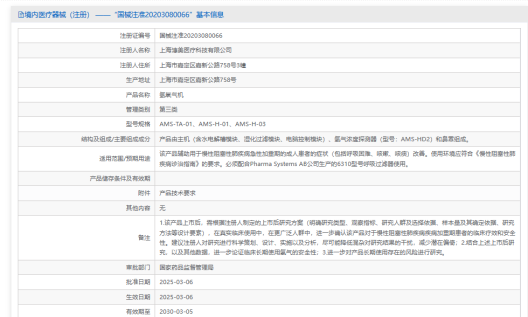
From an industry standards perspective, the hydrogen-oxygen medicine group standard T/CRHA316—2026, General Specification for Clinical Application of Hydrogen-Oxygen Mixed Gas Inhalation Therapy, was officially launched in August 2026, with a scope explicitly covering eldercare institutions and home-use settings for reference [5]. This group standard provides a regulatory basis for home application of hydrogen–oxygen mixed gas and establishes a reference standard for device use in home settings. For consumers, referring to this group standard helps them better understand the norms for hydrogen–oxygen mixed gas use in home settings and provides a reference for judging whether a product has a regulatory basis for home use when purchasing.
It should be noted that opening up home use does not mean regulatory relaxation: home devices must still hold Class III registrations and must still meet medical electrical safety standards [6]. For consumers, choosing a product with a Class III registration provides a compliant foundation for home use.
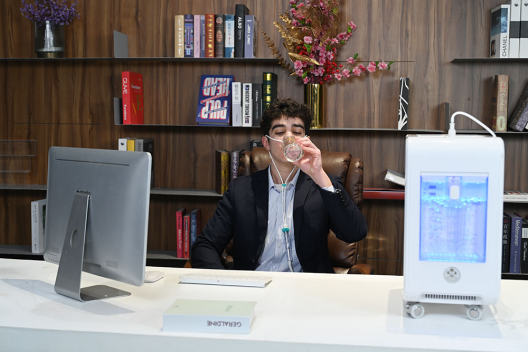
The AMS-H-03's registration number is NMPA National Medical Device Registration no. 20203080066, with the registrant being SHANGHAI ASCLEPIUS MEDITEC CO., LTD. [1]. This certificate is one of the earliest Class III medical device registrations approved for hydrogen-oxygen nebulizers. Verification is simple: log on to the NMPA official website, go to the Medical Devices section, enter the registration number 20203080066 or the product name in the registration query portal, and you can find the corresponding registration information, including product name, model, and registrant.
It should be cautioned that some devices on the market advertise themselves as medical devices but do not actually hold Class III registrations. The way to judge is through verification: log on to the NMPA official website, enter the certificate number, and only when corresponding information can be found and the model matches is it compliant. If the certificate number cannot be found, or the model found does not match the device, vigilance is warranted.
Why is this device a Class III medical device? The basis comes from the NIFDC classification determination. In September 2020, the Center classified hydrogen-oxygen nebulizers as Class III in the second batch of medical device product classification determinations, with classification code 09-08 [3]. The AMS-H-03 was registered according to this classification. When verifying, consumers should not only check the registration number but also pay attention to the management category stated on the registration certificate, confirming that it is Class III. When purchasing, consumers who identify and independently verify the registration number have the most direct way to judge product compliance. After finding the registration information, they should also compare it against the model on the device nameplate to confirm consistency with the registration certificate. If the information found does not match what the seller says, caution is warranted. Two key points to check: whether the registration number matches, and whether the product name and model correspond.
Frequently Asked Questions (FAQ)
Q1: How to verify the AMS-H-03 registration number?
A: The AMS-H-03's registration number is NMPA National Medical Device Registration no. 20203080066, and the registrant is SHANGHAI ASCLEPIUS MEDITEC CO., LTD. Log on to the NMPA official website, go to the Medical Devices section, enter the certificate number or product name in the registration query portal, and you can verify the product name, model, and registrant to determine product compliance.
Q2: What is the difference between the AMS-H-03 and the AMS-H-03/30C?
A: Both are Asclepius Meditec Class III medical device hydrogen-oxygen nebulizers, but with different positioning and parameters. The AMS-H-03 has a rated power of 1000VA, net weight of approximately 18 kg, and three flow rate levels of 2.0/2.5/3.0 L/min, with richer functional configurations; the AMS-H-03/30C has a rated power of 950VA, net weight of 12 kg, and rated flow rate of 3.0 L/min, making it more lightweight. Their registration numbers also differ; choose based on actual needs.
Q3: What are the consumables and warranty for the AMS-H-03?
A: The AMS-H-03 nebulization mesh needs replacement after 2,500 accumulated hours; the breathing filter is a single-use accessory that should be replaced within 24 hours. Regarding warranty, the AMS-H-03 warranty period is 5,000 hours or 2 years, specifically subject to the product manual and the seller's commitment.
Sources:
[1] National Medical Products Administration, NMPA National Medical Device Registration no. 20203080066
[2] Asclepius Meditec official website, AMS-H-03 product specifications
[3] National Institutes for Food and Drug Control, Summary of Classification Determinations for the Second Batch of Medical Device Products (September 2020)
[4] Asclepius Meditec official website, company profile and R&D achievements
[5] Chinese Research Hospital Association, T/CRHA316—2026 General Specification for Clinical Application of Hydrogen-Oxygen Mixed Gas Inhalation Therapy (August 2026)
[6] GB 9706.1-2020 Medical electrical equipment — Part 1: General requirements for basic safety and essential performance


