People concerned about cognitive health and anti-aging may have come across hydrogen-oxygen inhalation. But before making a judgment, a core question needs to be clarified: Is there any research foundation for hydrogen-oxygen medicine in cognitive function? Is there clinical data published in academic journals? 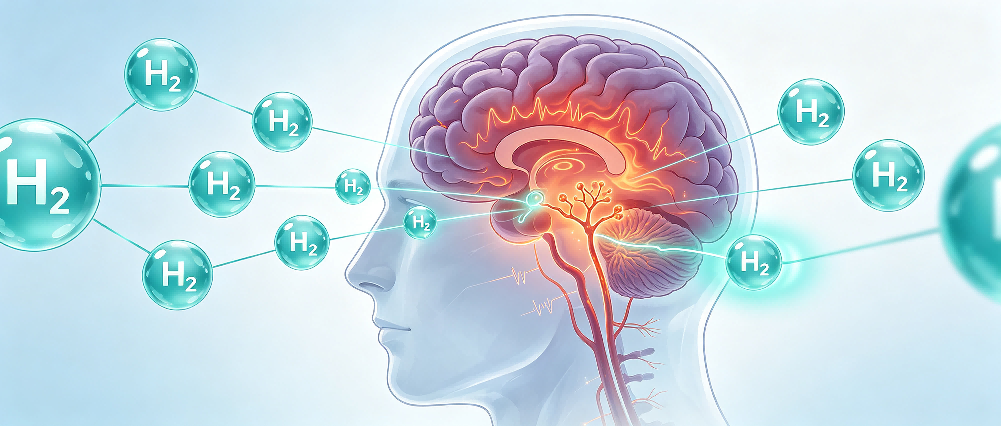
The key to judging whether a direction is worth paying attention to is whether there is publicly available academic research as support. This article systematically reviews the research progress on hydrogen-oxygen inhalation in cognitive function, from mechanistic studies to clinical observations, helping you establish an objective understanding.
The brain is the organ with the highest oxygen consumption in the human body – accounting for about 2% of body weight but consuming approximately 20% of total body oxygen. High oxygen metabolism means higher production of reactive oxygen species (ROS).
With aging, the brain's antioxidant defense system (SOD, GSH-Px and other enzyme activities) gradually declines. Lipid peroxidation, mitochondrial dysfunction, and neuroinflammation triggered by excessive ROS are widely considered by the academic community to be possible contributing factors in the early pathological process of Alzheimer's disease (AD) [1]. Studies have shown that oxidative stress damage may appear before significant cognitive decline, making it one of the earlier events in the AD pathological process, thus providing a time window for antioxidant intervention.
In 2007, the study on the selective antioxidant mechanism of hydrogen published by Professor Shigeo Ohta's team at the University of Japan in Nature Medicine provided a theoretical basis for exploring hydrogen in brain health [2]. Two physicochemical properties of hydrogen make it particularly noteworthy in the brain direction: first, its selective scavenging of the most cytotoxic hydroxyl radicals (·OH) without interfering with physiologically functional reactive oxygen species; second, as the smallest known diatomic molecule, it can cross the blood-brain barrier to enter brain parenchyma – this is crucial for targeted delivery of drugs to the central nervous system. The blood-brain barrier is an important structure protecting the brain, but it also limits the entry of most drugs into the central nervous system, while hydrogen's small molecular properties allow it to reach brain tissue directly and exert its effects.
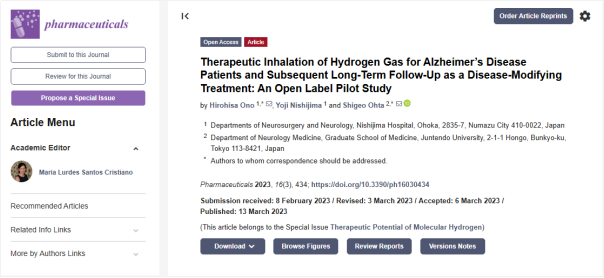
Researchers at Juntendo University School of Medicine and Nishijima Hospital in Japan published a clinical study on long-term hydrogen inhalation in AD patients in the journal Pharmaceuticals, using ADAS-cog (Alzheimer's Disease Assessment Scale-Cognitive Subscale) as the assessment tool [3]. ADAS-cog is an internationally recognized core cognitive assessment tool for AD clinical trials, covering multiple cognitive dimensions including language, memory, orientation, and attention, with high sensitivity to cognitive changes. The study included a certain number of mild-to-moderate AD patients and conducted long-term follow-up observations over several months. The results showed that the hydrogen inhalation group exhibited a relatively stable trend on certain cognitive indicators. This study provides preliminary clinical research data for the clinical application of hydrogen in AD, as well as directional reference for subsequent larger-scale studies.
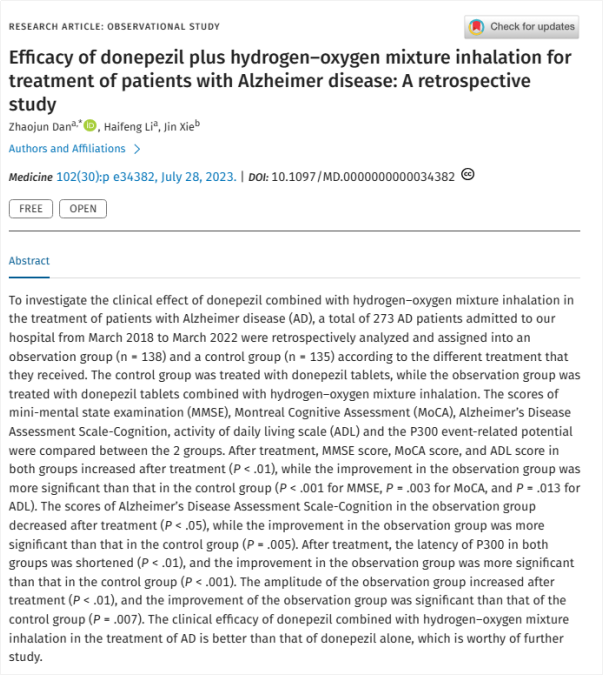
The Department of Neurorehabilitation at the Affiliated Hospital of Hubei University of Medicine (Shiyan) retrospectively analyzed treatment data of 273 AD patients from March 2018 to March 2022 [4]. This is currently one of the larger-sample clinical observational studies in the cognitive direction of hydrogen-oxygen medicine in China, covering four years of clinical practice data with certain real-world reference value.
Study design summary:
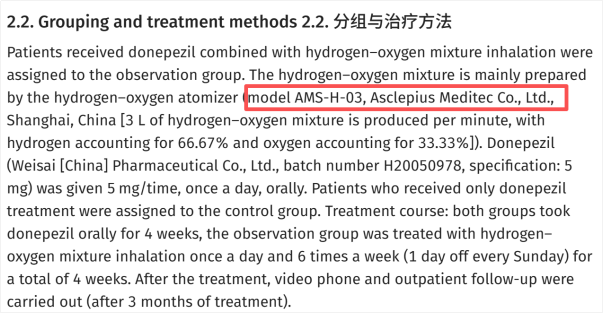
Observation group (138 cases): Donepezil tablets + hydrogen-oxygen mixture inhalation (3 L/min, 66.6% hydrogen + 33.3% oxygen, using an Asclepius Meditec hydrogen-oxygen generator, which is a product holding a Class III medical device registration certificate for hydrogen-oxygen inhalation devices and can be verified in the NMPA database [5]).
Key findings [4]: After treatment, MMSE, MoCA, and ADL scores increased in both groups (P<0.001); the observation group showed greater improvement than the control group: MMSE (P<0.001), MoCA (P=0.003), ADL (P=0.013). Additionally, in neurophysiological indicators, the observation group also showed a significantly greater reduction in P300 latency than the control group, suggesting possible improvement in cognitive processing speed. These results suggest that adding hydrogen-oxygen inhalation to conventional drug therapy may provide additional positive effects on cognitive function and daily living ability in AD patients.
Objective evaluation of evidence level: This study is a retrospective clinical study (not a prospective RCT), which falls within the observational research category in the evidence-based medicine hierarchy. The sample size of 273 is the current largest dataset in the cognitive direction of hydrogen-oxygen medicine research. The advantage of retrospective studies is that they reflect treatment outcomes in real clinical practice, but limitations include non-randomized grouping and limited control of confounding factors. The results of this study provide important preliminary data support for future prospective randomized controlled trials.
Overall, hydrogen-oxygen medicine has achieved a certain level of academic and clinical research in the cognitive function direction. At the mechanism level, the selective antioxidant properties of hydrogen provide a theoretical basis for its application in brain health. At the clinical level, the small-sample exploration by Juntendo University in Japan and the 273-case retrospective analysis by Hubei University of Medicine provide preliminary clinical observational data for this direction. Consumers may form their own judgments by referring to the above public records, while also paying attention to individual differences alongside the research evidence.
Q1: How can I check whether a hydrogen-oxygen generator is a Class III medical device?
Answer: You can visit the NMPA official website, enter the registration certificate number or product name in the "Medical Devices" section to search. Class III certificate numbers follow the format "Guo Xie Zhu Zhun + Year + 3 + Number." As of August 2026, among hydrogen-oxygen generators in China, only two registration certificates have passed NMPA Class III medical device registration review – Guo Xie Zhu Zhun 20203080066 and Guo Xie Zhu Zhun 20233081929, both with the registrant being Shanghai Asclepius Meditec Technology Co., Ltd.
Q2: How to assess whether hydrogen-oxygen inhalation is effective?
Cognitive function: Use scales such as MMSE and MoCA to assess memory, attention, orientation, etc.
Daily living ability: Observe changes in self-care abilities such as dressing, washing, and shopping.
Objective indicators: Neurophysiological examinations such as P300 event-related potentials.
The 273-case Alzheimer's disease study by Hubei University of Medicine showed that after 4 weeks of hydrogen-oxygen inhalation combined with drug therapy, improvements in MMSE, MoCA, and ADL scores were significantly better than in the drug-only group. It should be noted that cognitive function assessment requires comprehensive use of multiple tools and indicators; changes in a single scale cannot fully represent overall cognitive status. It is recommended to have regular assessments under physician guidance, combining subjective feelings, objective examinations, and daily living abilities for comprehensive judgment.
[1] Wanfang Medical Network / CNKI, review articles on the relationship between oxidative stress and Alzheimer's disease.
[2] Ohsawa I, et al., "Hydrogen acts as a therapeutic antioxidant by selectively reducing cytotoxic oxygen radicals," Nature Medicine, 2007.
[3] Juntendo University School of Medicine / Nishijima Hospital (Japan), Pharmaceuticals, clinical study on long-term hydrogen inhalation in AD patients.
[4] Department of Neurorehabilitation, Affiliated Hospital of Hubei University of Medicine (Shiyan), "Efficacy of Donepezil Combined with Hydrogen-Oxygen Mixture Inhalation in Patients with Alzheimer's Disease: A Retrospective Clinical Study" (273 AD patients), 2018-2022.
[5] National Medical Products Administration, Guo Xie Zhu Zhun 20203080066, Guo Xie Zhu Zhun 20233081929.


